What is Talent Management?
Talent management is the structured, data-informed process of attracting, developing, and retaining employees to achieve business objectives. It spans hiring, onboarding, performance management, career development, and succession planning. By aligning individual strengths with organizational needs, effective talent management improves engagement, reduces turnover, and builds long-term workforce capability.
| Key Takeaways |
|---|
Talent management is execution, not just strategy. It turns workforce plans into daily practices that shape hiring, development, and retention outcomes. It spans the full employee lifecycle. From recruiting and onboarding to performance management and succession planning, talent management connects every stage of the employee experience. Alignment drives performance. When employees are placed in roles that match their strengths and supported with clear expectations, engagement and productivity increase. Retention is a measurable outcome. Effective talent management reduces avoidable turnover, protects institutional knowledge, and lowers hiring costs. Managers play a critical role. Consistent coaching, structured feedback, and data-informed decisions are essential to scaling talent practices across teams. Success requires data, not intuition alone. Tracking retention, engagement, internal mobility, and performance metrics ensures talent decisions are defensible and aligned with business goals. |
How Organizations Put Talent Management Into Action
At its core, talent management is how organizations invest in their people over time. It goes beyond filling open roles and extends into how employees are supported, developed, and advanced throughout their careers.
In practice, this means:
- Recruiting candidates whose skills and behavioral strengths align with role and team needs
- Integrating new hires effectively so they can contribute quickly
- Providing structured feedback and coaching to support performance
- Offering ongoing learning and development opportunities
- Creating clear career pathways and succession plans to retain high performers
When these efforts are connected and aligned with business priorities, talent management becomes more than a series of HR initiatives. It becomes a coordinated system for building capability, reducing turnover risk, and strengthening long-term organizational performance.
Learn more about how to optimize your organization’s talent management practices:
Why is talent management important?
Talent management offers a wide range of benefits throughout the talent lifecycle, including a stronger company culture, a more positive employer brand reputation, and reduced costs and disruptions associated with employee turnover.
By aligning employees with projects, roles, and teams that are compatible with their interests and natural abilities, you can encourage greater discretionary effort. And when employees go the extra mile in their role, it tends to unlock creativity, innovation, and a stronger cross-functional understanding of the organization and its objectives.
Invest in talent management initiatives that prioritize learning and development—whether through continuing education, training programs, or mentoring. In doing so, you can improve employee performance while instilling confidence in your people and their work.
Additional talent management resources:
- What is talent mapping?
- Managing talent in a time of turmoil
- 20 management skills for talent optimizers
How does a talent management strategy work?
A talent strategy works when it connects business goals to the people practices that drive day-to-day performance. It’s not just a plan—it’s a system for consistently hiring, developing, and retaining people in roles where they can succeed.
High-performing organizations tend to focus on a few levers:
- Make culture actionable, not aspirational. Define the behaviors you expect from leaders and teams—and reinforce them through hiring, coaching, and feedback.
- Build visible growth pathways. Retention improves when employees understand what “good” looks like and how to develop toward their next step.
- Match people to roles using more than resumes. Role fit improves when you consider not only skills, but also behavioral strengths and team dynamics.
- Enable managers to lead consistently. The manager experience shapes the employee experience; equip managers with structured tools for communication, coaching, and performance conversations.
- Use data to diagnose, not just report. Track leading indicators like engagement and misalignment so you can intervene before performance drops or people leave.
When these elements work together, talent strategy becomes a repeatable way to improve engagement, reduce avoidable turnover, and build the capabilities the business needs next.
What does talent management include?
A successful talent management strategy requires a multi-faceted approach that includes (but is not limited to) the following components.
Business strategy planning
Clearly define the objectives of the business and identify which core values and skills are necessary to achieve those goals.
Talent acquisition
Optimize the recruiting, hiring, and onboarding process to attract and recognize top talent, and help new employees integrate into their new role comfortably and with confidence.
Performance management
Evaluate employees, collect data on strengths and competencies, and align individuals with projects, teams, and roles that help maximize their professional potential.
Career development
Provide opportunities for employees to develop or expand existing proficiencies, aptitudes, or skills. Upskilling can help create top performers and prepare talent for future roles within the organization.
Succession planning
Build talent development strategies and create a career path for employees that offers opportunities for growth within the organization, and make transitions to new roles as seamless as possible. Build talent development strategies to help employees grow.
Read more about the key components of talent management:
Talent management examples
The basis of successful talent management is recognizing and supporting your employees’ personal and professional growth.
Employees who feel appreciated and empowered to succeed are more likely to feel a sense of ownership in business outcomes and are less likely to pursue outside opportunities. Also, acknowledging your team’s talent and potential is a nice gesture, making it a win-win for everyone involved.
So, what does good talent management look like? Let’s consider some real-world examples and clients we’ve worked with.
Master Electronics
Master Electronics implemented structured behavioral assessments in hiring and provided new hires with personalized Relationship Guides during onboarding to show them how to communicate effectively with their managers. They reduced distribution center attrition from 111% to 58% and saved $2 million in turnover costs.
Centier Bank
Centier Bank created behavioral Job Targets for key roles and used assessments to match candidates to positions where they’d naturally excel. They leveraged behavioral data to identify future leaders and move existing employees into roles that optimized their strengths, dropping turnover to 7%—well below industry averages.
Learn more about talent optimization strategies:
- What are talent assessments?
- Behavioral data: What it is and what it means for a remote workforce
- Company culture: Why it matters and how to build it effectively
Steps to create a talent management strategy
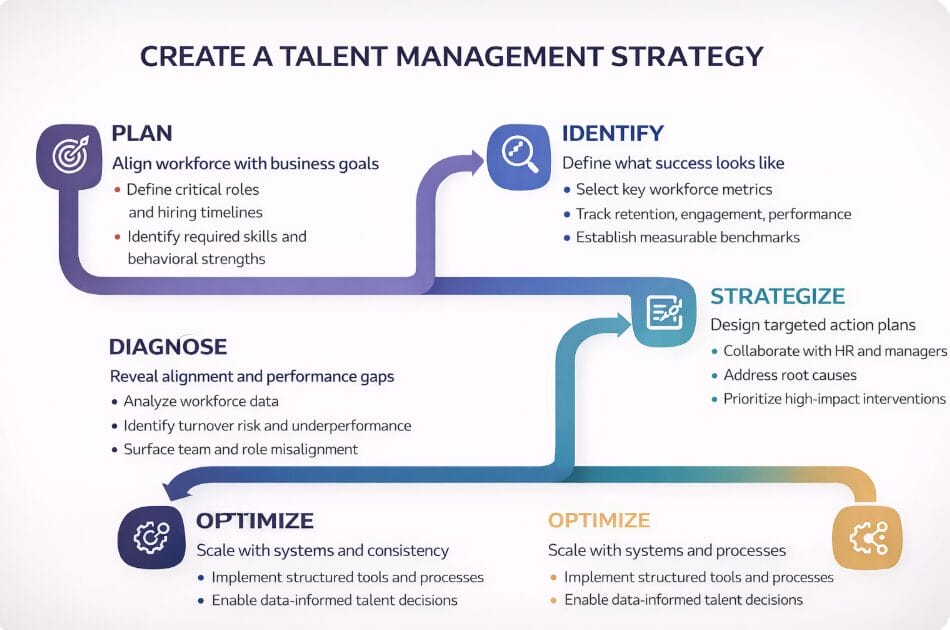
Creating a talent management strategy consists of the following steps.
Step 1: Plan
Strategic workforce planning is imperative. Evaluate how many people you need to hire, what roles or departments they are needed in, what skills or behaviors would be best suited for those roles, and when the positions need to be filled.
Step 2: Identify
Decide which data will be collected and used to quantify the success or weaknesses of your plan. Employee turnover rates, employee engagement surveys, exit interviews, and KPIs for individual and departmental performance are all helpful metrics for evaluation.
Step 3: Diagnose
Use existing data to pinpoint talent obstacles in your current strategy. Assess where problem areas exist, which employees and departments are underperforming, and if there is any misalignment between employees and their current roles or teams.
Step 4: Strategize
Create a plan to mitigate or eliminate obstacles. Interview key stakeholders, such as HR professionals and managers, for suggestions.
Step 5: Optimize
Identify software or tools that may support human capital management initiatives. Talent management systems or talent optimization software may offer a streamlined solution for implementing an effective, enduring talent strategy.
For additional information about developing a talent management strategy, read:
- How compensation plays into attracting and retaining top talent
- Workforce planning to meet today’s goals and tomorrow’s
Talent management best practices
The specifics of talent management strategies vary by organization and objectives, but effectively integrating the following best practices into your plan can increase your likelihood of success.
Attract and hire the right people
From crafting detailed job descriptions to asking the right interview questions, finding and recognizing ideal candidates is the strongest starting point when it comes to talent management. Don’t focus solely on work history—tasks can be taught, but character, intellectual curiosity, and creativity may be better indicators of potential than past experience.
Prioritize strong leadership
Having engaged managers who are interested in their employees, value communication, and understand how individual strengths can be leveraged to achieve business outcomes is a crucial component of talent management. Quality leadership is a tremendous asset when it comes to developing and retaining top talent.
Evaluate people and performance
Regular performance appraisals are important, but it’s important to get to know your employees beyond their productivity. Behavioral assessments can help you understand an individual’s strengths, communication skills, collaboration style, and compatibilities that may make it easier to identify untapped talent. Likewise, regular engagement surveys can help reveal performance obstacles, misalignments, or process bottlenecks while also demonstrating that you’re interested in and willing to act on employee feedback.
Build cross-functional teams
Reallocate talent to new roles and projects strategically as priorities change. Creating cross-functional teams designed to inspire innovation and support collaboration can give employees a broader perspective of your organization and its objectives while also providing new learning opportunities.
Make work worth it
The best retention strategy is to create a positive work environment where talent feels appreciated and supported. Ensuring that empathy, integrity, and healthy work/life balance are core components of your company culture can pay off for years to come.
Learn more about successful talent management techniques:
Measuring the success of talent management
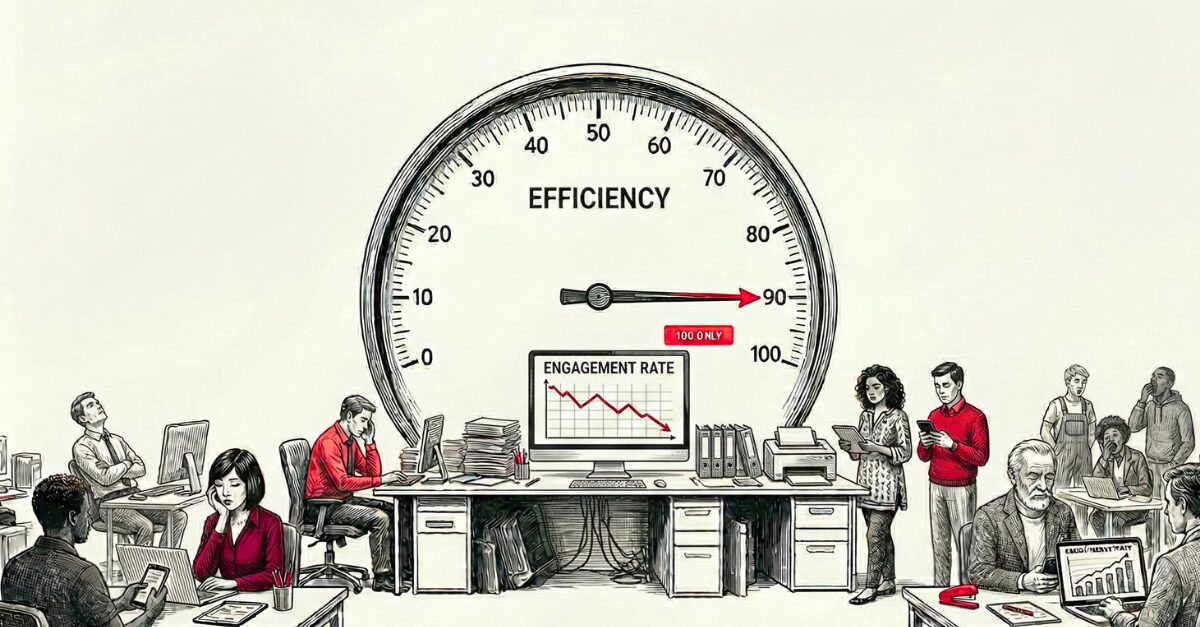
You can’t improve what you don’t measure. To understand whether your talent management efforts are working, you need to track metrics that reveal how effectively you’re attracting, developing, and retaining your people.
The most useful KPIs connect directly to business outcomes. When you see improvement in these areas, you’re not just managing talent better—you’re building organizational capability that drives results.
Employee retention rates
Retention tells you whether people want to stay. Track overall employee retention as well as retention by department, role, and tenure. High turnover in specific areas often signals misalignment between employees and their roles, managers, or teams. If you’re losing people within their first year, look at your hiring and onboarding processes. If tenured employees are leaving, examine development opportunities and career progression.
Time-to-fill vacancies
This metric measures how quickly you can get the right person into an open role. Extended time-to-fill creates operational strain, overburdens existing team members, and can cost you top candidates. A streamlined process, with clear job targets, efficient interviewing, and data-driven candidate evaluation, helps you fill positions faster without sacrificing quality.
Employee engagement scores
Engagement surveys reveal how connected employees feel to their work, their teams, and the organization. Low engagement often precedes turnover, so tracking this metric helps you intervene before people leave. Look for patterns across teams or departments that might indicate specific management or alignment issues.
Internal promotion rates
When employees advance within your organization, it demonstrates that you’re developing talent effectively and creating clear career paths. Internal promotions also tend to be faster, less expensive, and less risky than external hires. Track what percentage of leadership and critical roles are filled internally versus externally.
Training completion and effectiveness metrics
Completion rates show whether employees are engaging with development opportunities. But effectiveness matters more than completion. Measure whether training translates into improved performance, behavior change, or skill application. Use pre- and post-training assessments, manager feedback, and performance data to evaluate impact.
These metrics work best when viewed together, not in isolation. An uptick in engagement paired with higher retention rates suggests your talent management practices are resonating. On the flip side, strong training completion but low internal promotion rates might indicate you’re developing people without creating advancement opportunities.
The goal isn’t perfection in every metric. It’s continuous improvement guided by data that helps you make smarter decisions about your people.
How can PI help develop your talent management process
As a talent optimization platform, The Predictive Index offers a suite of tools that empower your organization with the information to help engage employees, strengthen leadership, and create alignment between talent and business objectives.
- Hire the right person for the right role. Use millions of data points within our hiring software, and hone in on your ideal candidate.
- Inspire people with your leadership. Improve communication with direct reports, and use our coaching guide to bring out their best work.
- Design cohesive and collaborative teams. Identify strengths and weaknesses as a team, and bridge areas of misalignment between your team’s abilities and its goals.
- Diagnose disengagement in your workplace. Use science-backed pulse surveys to solicit honest, anonymous feedback, and get prescriptive recommendations to boost engagement.
Learn more about talent management and creating top-performing teams that win:
FAQ’s
What is the difference between talent management and talent development?
Talent management is the broader system for attracting, developing, and retaining employees across the entire workforce lifecycle. It includes hiring, onboarding, performance management, succession planning, and retention strategies.
Talent development is a component of talent management focused specifically on building skills, leadership capability, and career growth. In short, talent development strengthens employee capability, while talent management ensures that capability is aligned with business needs.
Who is responsible for talent management in an organization?
Talent management is a shared responsibility. HR leaders design the systems and frameworks, executives align talent priorities with business strategy, and managers execute day-to-day practices such as coaching, performance conversations, and development planning.
While HR may own the strategy, managers ultimately shape the employee experience. Effective talent management depends on consistent execution across leadership levels.
What are common talent management challenges?
Common challenges include inconsistent manager practices, lack of clear role definitions, limited visibility into workforce data, and misalignment between development initiatives and business priorities. Organizations may also struggle with reactive hiring, unclear succession plans, and insufficient measurement of engagement or retention risk.
Overcoming these challenges requires structured processes, data-informed decision-making, and alignment between talent strategy and operational execution.

Get the most out of your remote employees
Download our free guide, and better understand the motivation of your people – no matter where they are.