
AI isn’t here to eliminate your role. It’s here to elevate it.
Open LinkedIn right now, and you’ll see posts: “Algorithms are hiring, chatbots are coaching, and automation is sweeping through the back office.” It’s enough to make anyone in HR feel a little uncertain… If AI can screen resumes faster than a recruiter and answer benefits questions instantly, where does that leave the human HR manager?
Here’s the reality: AI isn’t going to replace HR managers. But HR managers who use AI will replace those who don’t.
Just as the spreadsheet didn’t kill the accountant, it made them a CFO. AI isn’t here to eliminate your role. It’s here to elevate it. Think of it as a multiplier. It frees you from the repetitive admin work that drains your energy so you can focus on what no machine can replicate: empathy, strategy, and real human connection.
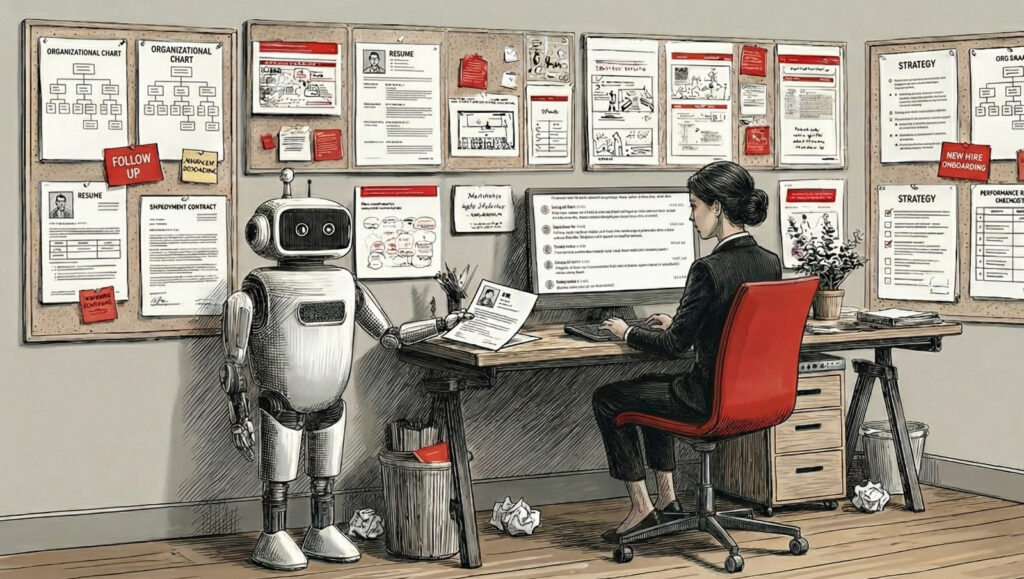
What is AI Already Doing in HR?
Artificial intelligence isn’t just a futuristic concept anymore; it’s the engine running quietly beneath modern people operations.
Right now, AI is acting as a massive efficiency lever. It’s processing payroll anomalies in seconds, grading candidate assessments to predict job fit, and scanning employee sentiment data to flag burnout risks before people quit. In fact, recent reports reveal that industries most able to use AI are achieving 3x higher growth in productivity compared to those that don’t.
This shift means the “administrative gatekeeper” version of HR is fading. In its place, we’re seeing a more strategic, data-driven HR leader emerge; one who spends less time on paperwork and more time on people strategy.

This is HR’s moment to emphasize people strategy.
Check out our latest eBook – HR’s playbook for the AI era – and help ensure the human impact of AI rollout isn’t overlooked.
Which HR Leadership Tasks Can AI Automate?
To see where you fit in, it helps to look at the difference between tasks (which AI handles well) and jobs (which need your judgment).
Transactional Tasks
These are the high-volume tasks that probably eat up hours of your week. AI is already great at these.
- Payroll & Benefits Admin: Automated systems can handle deductions, tax compliance, and open enrollment queries without the errors that come from manual entry.
- Scheduling: AI agents can coordinate interviews between five different calendars instantly, finally replacing the endless email tag.
Operational Tasks
These tasks need some data processing but usually follow a set of rules.
- Candidate Prioritization*: Instead of sifting through stacks of resumes hoping to spot a keyword, tools like PI Hire help you rank candidates based on their behavioral and cognitive fit for the role- based on a job target you create. This lets you bypass “resume fatigue” and focus immediately on the applicants who are naturally wired to succeed in the position- without unknowingly injecting the bias that comes with most AI hiring tools. *It is strongly recommended you do not use AI exclusively to select a candidate for a role, promotion, or placement decision. See PI’s position on AI.
- Policy FAQs: Chatbots can answer “How many vacation days do I have?” 24/7, so you don’t have to be the company help desk.
Strategic Tasks
Here, AI becomes your partner, not your replacement.
- Workforce Planning: AI can crunch turnover data and predict hiring needs for Q3. But you are the one deciding how to budget for those roles and how they align with the business strategy.
- Performance Reviews: AI can summarize a year’s worth of feedback into a draft review. You need to refine that message to ensure it lands constructively and actually motivates the employee.
Relational Tasks
This is your advantage, the work AI simply cannot touch.
- Conflict Resolution: An algorithm can’t navigate the complex emotional history between two feuding managers.
- Coaching & Mentorship: Empathy, active listening, and building psychological safety are inherently human traits found in great leaders, not software.
- Culture Building: Tools can measure sentiment, but they won’t inspire trust or model company values during a crisis without you.
Real World Examples
We are already seeing the “Human x AI” partnership play out in real time.
Reducing Headcount (The Wrong Way vs. The Right Way)
Some organizations worry that AI is just an excuse to cut teams. However, a recent EY US AI Pulse Survey suggests only 17% of employers are reducing headcount due to AI. The smarter organizations are using that efficiency to pivot. Instead of having three generalists drowning in paperwork, they have three specialists focused on retention, learning, and development.
Evolving HR Roles
Take the role of a recruiter, for example. Previously, they might spend 30 hours a week just sourcing and screening. Today, AI agents handle the sourcing and initial outreach. That recruiter’s role evolves into a “Talent Advisor,” spending those 30 hours interviewing finalists, selling the company vision, and closing candidates… high-value work that drives business results.
Key HR Operation Automations
We see customers using our own AI-driven tools to close the gap between data and action. For example, instead of manually reading through hundreds of employee experience survey comments to find themes, leaders now use PI Diagnose to instantly summarize sentiment and recommend specific actions to fix disengagement. It turns a two-week analysis project into a two-minute insight. (See how Club16 did it).
How Can Someone in HR Adapt & Future-Proof Their Role?
It’s valid to worry about keeping up with technology, but the path forward is clearer than you might think.
- Become the “Human” Expert: As AI handles the data, your value lies in behavioral expertise. Deepen your understanding of what drives people—their needs, drives, and cognitive styles.
- Experiment Safely: You don’t need to be a coder. Start small. Use generative AI to draft a job description or summarize a meeting. The goal is to get comfortable with AI as a tool, not a threat.
- Shift to Strategy: Stop rewarding yourself for “busy work.” If a task can be automated, let it be automated. Use that recovered time to align your talent strategy with the business goals.
Conclusion
So, will AI replace HR managers? No. It’s going to replace the parts of the job that keep you stuck in the weeds.
We believe AI is a multiplier. It empowers you to act faster, predict better, and solve problems that used to seem impossible. But at the center of every hiring decision, every promotion, and every difficult conversation, there has to be a human.
The future of HR isn’t digital-only; it’s human-first, AI-enabled. The managers who embrace this partnership will find themselves not just relevant, but indispensable.
Frequently asked questions we hear from HR leaders:
Will AI completely replace HR managers someday? No. While AI will automate administrative and analytical tasks, it lacks the emotional intelligence, empathy, and ethical judgment required for leadership, conflict resolution, and culture building.
Which HR functions are most at risk of automation? Repetitive, rules-based tasks are most at risk. This includes payroll processing, benefits administration questions, initial resume screening, and interview scheduling.
What HR tasks should a human always handle? Humans need to handle sensitive employee relations issues, complex conflict resolution, final hiring decisions, high-stakes negotiations, and cultural leadership. AI should not be used to exclusively select candidates- they have inherent bias that can catch up with you down the road.
What new leadership roles will replace traditional HR roles? We expect to see titles shift from “HR Generalist” to roles like “Chief Productivity Officer”, “People Strategy Lead,” “Employee Experience Architect,” and “Talent Operations Manager,” focusing on strategy over administration.
How can HR leaders reskill for the AI era? Focus on three areas: Data Literacy (understanding what AI tells you), Behavioral Science (understanding people deeper than data can), and Strategic Alignment (connecting people data to business results).