
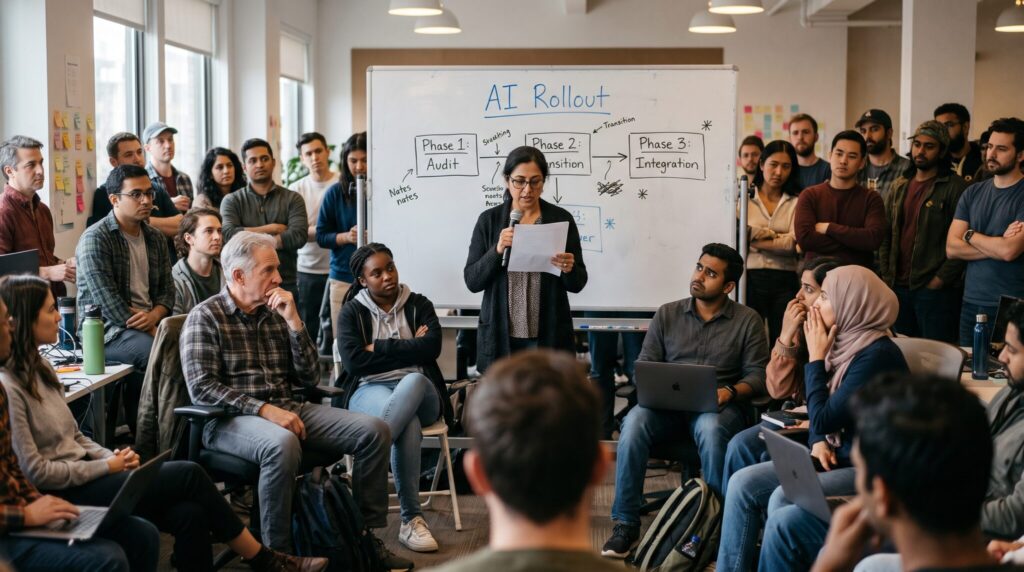
Every week, another company announces an AI mandate. Use it for meeting notes. Use it to write job descriptions. Use it to move faster. The directive comes from the top, and then it trickles down through layers of managers and teams, each one interpreting it a little differently.
By the time it reaches employees, “use AI” means something different in every corner of the organization. That inconsistency is a major problem that has little to do with the technology itself. According to a recent KPMG report, the biggest barriers to AI adoption are slow organizational change management and a lack of role-specific use cases — not the tools themselves. And yet HR leaders are expected to bridge that distance with no shared definition of what good adoption actually looks like.
The organizations making real progress are defining what AI use looks like in practice by role, team and even expected behavior. That work falls to HR because adoption depends on people changing how they work, and that requires clear expectations, aligned managers and the psychological safety to experiment.
How vague direction becomes inconsistent execution
When a mandate lacks definition, managers fill in the blanks themselves. One team treats AI as a writing tool. Another uses it to automate reporting. A third hasn’t touched it at all because no one explained what “good” looks like for their function.
That variation compounds quickly. The further direction travels from the executive level, the more it gets filtered through each manager’s assumptions, priorities and comfort level with the technology. By the time it reaches individual contributors, expectations are uneven at best and contradictory at worst.
Employees notice, with some feeling the pressure to use AI for tasks it isn’t suited for, while others are left wondering whether their reluctance will be held against them. That ambiguity slows adoption significantly while creating real anxiety about job security and performance expectations.
What companies end up with is fragmented experimentation instead of intentional adoption. According to a report from Infosys and MIT Technology Review, 83% of business leaders say psychological safety has a measurable impact on the success of AI initiatives. Without it, employees won’t experiment, ask questions or admit when something isn’t working. That means the organization never builds the kind of honest feedback loop that actually improves adoption over time.
The pressure HR is absorbing
HR is caught managing tensions between leadership, who want productivity gains, and employees, who need time to adapt. Both are reasonable expectations, and HR is responsible for holding them at the same time without a clean solution in sight.
The slow pace of AI adoption is making HR’s position that much harder. When change moves faster than people are ready for, stress, disengagement and burnout risk rise quickly. These results then get attributed to performance issues rather than a rollout that outpaced its own support structure.
On the compliance side, HR also has to weigh the pressure to experiment against real risk exposure around data privacy, bias in AI-assisted decisions and regulatory requirements that’re still catching up to the technology. The pressure to move fast and the obligation to manage risk responsibly are pulling HR in opposite directions.
HR is expected to operationalize AI transformation without always having the authority to shape how it gets defined. The mandate comes from the top, while HR is left to deal with the consequences.
Operationalizing AI adoption
Companies must treat AI adoption as a communication problem and start treating it as an operational one if they want to see real progress. That means going beyond the mandate to define what AI-enabled work actually looks like in practice for everybody across the board.
Here are a few things that organizations can focus on now, and should do so consistently:
- Role-specific expectations. Employees need to know what good AI use looks like in their function, not just in general. That means documenting concrete use cases by role and building those expectations into onboarding, performance conversations and team norms. Don’t leave it to each manager to figure out independently.
- Manager alignment. Managers are the primary multiplier of adoption consistency. Calibrating them means giving them a shared definition of success, regular forums to surface what’s working and what isn’t and clear guidance on how to coach employees through the transition.
- Psychological safety. Employees won’t experiment, admit mistakes or ask for help unless they feel safe doing so. Building that safety starts with leaders modeling the behavior they want to see by asking questions openly, acknowledging uncertainty and treating early AI experimentation as learning rather than performance.
AI adoption is ultimately a behavior change challenge. Organizations can build something durable and truly transformative when they treat it that way — and give HR the authority to lead it.
Ready to take on AI adoption at your organization? Learn how PI supports HR leaders through change.