
You finish the PI Behavioral Assessment and a label comes back. Maybe you’re a Maverick, or a Collaborator, or one of the other 15 Reference Profiles. Most people read the description, nod at the parts that fit, and move on. Fewer stop to ask how the label got picked in the first place.
The answer is simpler than most people expect. It also clears up the thing that confuses teams most, which is why two coworkers with nearly identical results can walk away with different profiles.
Your pattern comes first
The Behavioral Assessment measures four factors: Dominance, Extraversion, Patience, and Formality. Your results place you somewhere on each one, and those four placements together make up your behavioral pattern.
The pattern is the real result. Your Reference Profile is shorthand for it, a name you can use in a meeting instead of reading out four factor placements.
Neighborhoods and addresses
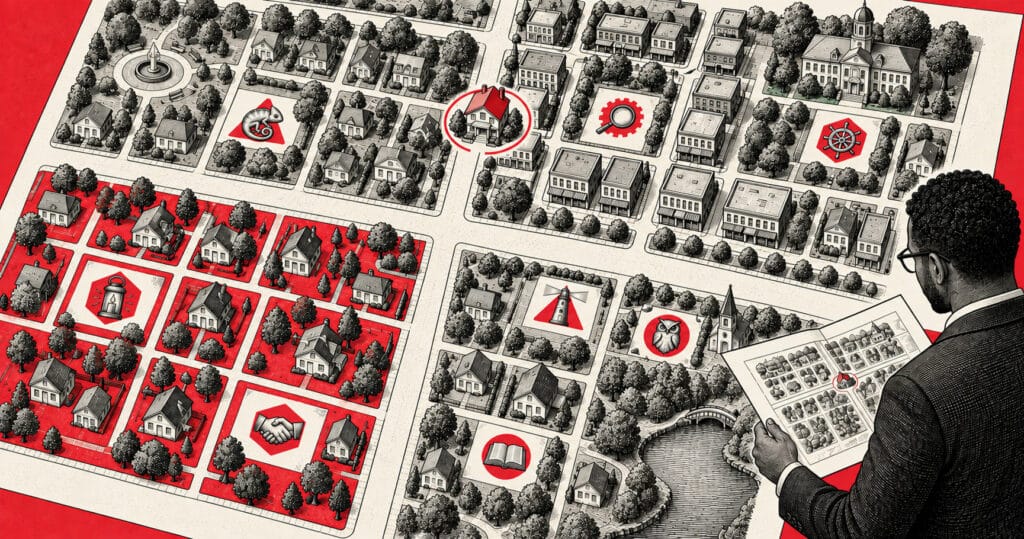
Here’s a useful way to picture it. Your pattern is your exact street address, and your Reference Profile is the neighborhood that address sits in.
Plenty of addresses share a neighborhood. Two Persuaders won’t have identical patterns. They’re close enough to share a name, and sharing a name is all the profile promises.
How the match is made
Each of the 17 Reference Profiles has a prototype, a typical pattern that sits at the center of that neighborhood. When you finish the assessment, PI places your four factor scores on a common scale and measures how far your pattern is from each of the 17 prototypes, using straight-line distance.
Whichever prototype is closest becomes your Reference Profile. Nobody reviews your results and picks a label for you, and the software isn’t reading the visual shape of your graph. Because it’s a distance calculation, the same pattern gets the same profile every time.
Why near twins get different profiles
This is the part that trips people up. You and a colleague compare results, your patterns look almost the same, and yet you’re a Controller and they’re an Analyzer.
You’re both standing near the edge between two neighborhoods. A small difference in a single factor is enough to make a different prototype mathematically closer. It’s like living on a street where the zip code changes halfway down the block: your neighbor across the road gets a different postmark, even though you both shop at the same grocery store.
If that’s you, read both profile descriptions. People who sit near a boundary usually recognize themselves in each one, which is exactly what the math would predict.
The four groups
PI sorts the 17 Reference Profiles into four groups, and each group has its own shape in the software.
| Group | Shape | General tendencies | Reference Profiles |
|---|---|---|---|
| Analytical | Gear | Task-focused and fast-paced, more decisive and independent than socially expressive | Analyzer, Controller, Specialist, Strategist, Venturer |
| Social | Hexagon | People-oriented and outgoing | Altruist, Captain, Collaborator, Maverick, Persuader, Promoter |
| Stabilizing | Triangle | Steady, detailed, and drawn to structure | Adapter, Artisan, Guardian, Operator |
| Persistent | Circle | Task-oriented and deliberate, with a strong need for stability | Individualist, Scholar |
How to use your Reference Profile
Reference Profiles are good at starting a conversation. They give a team a shared vocabulary for coaching, onboarding, and working out why two people keep talking past each other.
They’re less good at the detail. When the conversation turns specific, like how to give someone feedback or whether a person fits a role, go back to the four factor placements. The neighborhood tells people roughly where you live. Your pattern tells them which house is yours, what color the door is, and whether there’s a garden gnome by the steps.
To see all 17 side by side, browse the Reference Profiles. For the full methodology, read the introduction to Reference Profiles.