

To become a great leader you must take control over one major part of yourself: your ego. Keeping your ego in check is a lifelong pursuit.
As Charles Duhigg explained in his book “The Power of Habit,” our bodies naturally want us to create habitual behaviors. Basically, our brains try to find the most efficient way to complete a task, or to make a task repetitive, so we don’t have to consciously think about our actions.
This means we’re not naturally aware of our actions.
So even when you think you’ve finally tamed your inner ego beast, it rears its self-indulging head at the worst possible moments. Like when your team is counting on you to make rational judgement calls.

As Ryan Holiday said in his wonderfully-titled book “Ego is the Enemy”:
“The pretense of knowledge is our most dangerous vice, because it prevents us from getting any better. Studious self-assessment is the antidote.”
Being a great leader doesn’t mean you have all the answers, it means you can engage with your employees and inspire them to greatness.
Now, you could make an argument that one’s ego can be the catalyst that sparks innovation in most fields—especially in architecture, entertainment, and advertising. But, ego is what stops organizations from reaching their full potential.
So how does a leader recognize and take control over his or her ego? Through increased self-awareness. It’s the one trait all great leaders must possess.
Great leaders must work at being more self-aware.
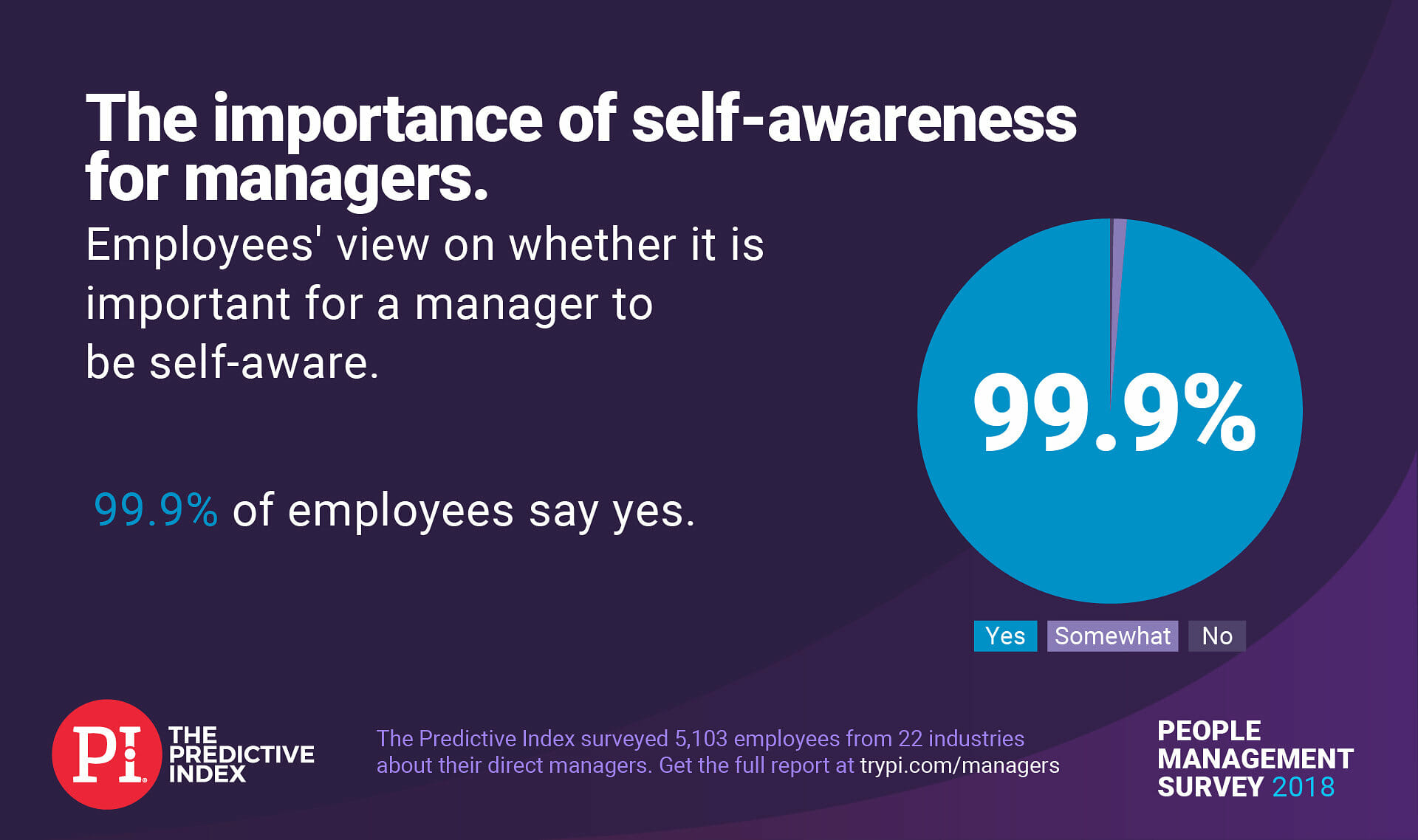
In our 2018 people management study, 99.9 percent of all respondents said that self-awareness was the number one trait for great managers. This means that out of 5,103 respondents, 5,102 said that self-awareness was a trait of a great leader.
Self-awareness is a honed skill, not a gift you’re born with. Like keeping your ego in check, you need to make an ongoing effort to be self-aware.
As you become more self-aware, you start to gain seemingly superhuman abilities. You:
- Start to make tough decisions from an almost third-party like perspective
- Can easily read other people’s emotions
- React to stressful situations rationally and keep your composure
- Stop saying or doing things you might eventually regret
The by-product of self-awareness is empathy.
Empathy enables us to communicate more efficiently and better understand the wants and needs of those around us. It makes us more in-tune with the people we support so we can best help them reach their professional and personal development goals.
Simple tips for increasing self-awareness and becoming a better leader

Practice active listening.
Active listening means you are:
- Attentive
- Asking questions
- Asking for clarification when in doubt
- Summarizing at the end
Active listening shows your employees you care about the things they have to say. It also means fewer miscommunications.
Take a psychometric or behavioral assessment.
You can take a behavioral assessment for free to become more self-aware. It takes about six minutes and the results will help you understand your natural behavioral drives.
Join 10,000 companies solving the most complex people problems with PI.
Everyone has an almost pre-programmed way their mind and body react in stressful situations. By understanding your natural drivers, you’ll be able to recognize and understand why you feel and act the way you do—and course correct.
Avoid the habit of fostering negative thoughts.
When things don’t go as planned it’s much easier to blame others and foster negative emotions. However, when you do this, you’re immediately forgoing a perfect learning opportunity. Try and force yourself to confront the uncomfortable. It’s one of the best ways to grow.
Take ownership.
Start to accept responsibility for the actions of not only your subordinates but your entire team. As a leader, you need to take ownership and accountability when things go wrong.
Trust your team.
Finally, build a team you can trust and truly rely on. Many leaders fail to give up full control of projects and get stuck in the weeds micromanaging. This creates frustration and a feeling of disenfranchisement. When you empower your team to creatively solve problems, you’ll notice that they’ll start tapping into discretionary effort and doing great work.
Self-awareness is essential to leadership. Without it you’ll never get the results you want. But remember, it’s not a natural gift. It’s something you have to work on and keep at.