Key Takeaways
- The attention economy is driving leaders toward reactive, surface-level decision-making — and most don’t realize it’s happening.
- Reactive leadership feels productive but replaces strategic judgment with decision fatigue.
- Discernment- the ability to separate signal from noise- is now the most valuable leadership skill.
- Leaders who understand their own behavioral patterns can resist reactivity and lead with depth.
- Attention management, not charisma or vision, is what separates effective leaders in 2026.
The same dopamine loop driving teenage TikTok addiction is now showing up in the C-suite. The way leaders consume information has become dangerously superficial.
People aren’t actually reading anymore. They’re scanning headlines, getting AI-generated summaries and reacting emotionally to hot takes before they’ve actually thought through what they’re reading. And leaders are getting pulled into that same dopamine loop.
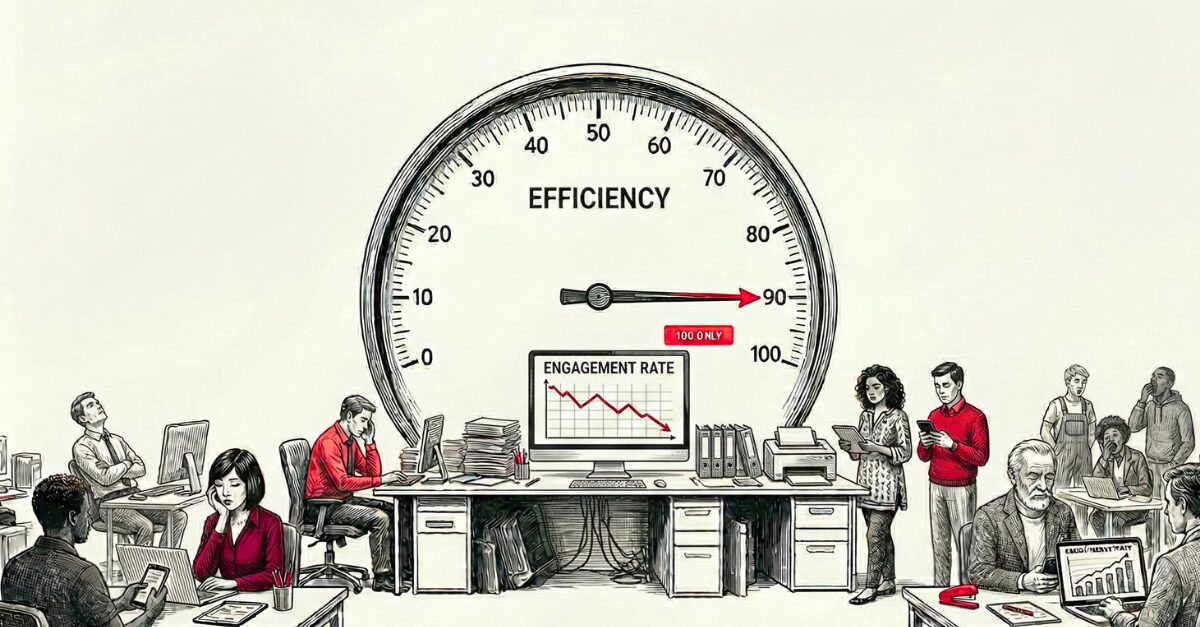
Leaders are making faster, more reactive decisions. Today’s leadership requires slowing down enough to discern what actually matters and make decisions based on depth rather than speed. Without that shift, organizations end up looking busy without actually solving the issues that matter most to their people.

The Cost of Reactive Leadership
Reactive leadership feels productive because it’s visible and constant — but visibility doesn’t equal effectiveness. Here’s what it looks like in practice:
- Making decisions based on the latest headline rather than underlying patterns
- Resharing trending content without thinking critically about whether it’s relevant to your organization
- Jumping into problem-solving mode before fully understanding the problem
- Being always “on” but rarely making meaningful progress
Research from the Institute for Organizational Science and Mindfulness found that workers spend an average of 47 seconds or less on a task before self-interrupting, and after each interruption, it takes 23 minutes to regain focus. That cycle compounds when leaders are making more decisions than ever. The result? Decision fatigue replaces judgment.
What Leadership Discernment Actually Looks Like
Discernment is the opposite of reactivity. It’s asking better questions before offering answers. It means sitting with uncertainty long enough to see what’s actually happening — and resisting the urge to form conclusions before you’ve truly listened.
When leaders skim instead of listen, they miss critical emotional signals. Forty-four percent of employees report being passed over for opportunities because their skills were misinterpreted. Disengagement, burnout, and quiet frustration go unnoticed because leaders are always half-present.
Research from the Institute for Organizational Science and Mindfulness demonstrated that attention has become today’s productivity gap, something many leaders are experiencing themselves. Workers spend an average of 47 seconds or less on a task before self-interrupting, and after each interruption, it takes 23 minutes to regain focus. That cycle compounds when leaders are making more decisions than ever, with less time for mental recovery between them. The result? Decision fatigue replaces judgment.
Organizational issues require depth, not speed. Leaders need the ability to separate signal from noise, and that only happens when they slow down enough to process what they’re seeing.
How to Prioritize: Urgent vs. Important
The Eisenhower Matrix isn’t new advice, but it’s more relevant now than it’s ever been. The framework is simple: urgent tasks demand immediate attention, while important tasks contribute to long-term goals and values. The problem is that everything feels urgent when you’re operating in a constant state of reactivity.
Leaders need to stay aware of the hundred things happening in their business without letting that awareness turn into a distraction. This is a core component of adaptive leadership: keeping the main thing the main thing while navigating change.
In practice, this means:
- Having slower, deeper conversations instead of rapid-fire check-ins
- Actually listening during those conversations, not mentally drafting your response
- Choosing what not to react to, which is often harder than choosing what deserves your attention
In 2026, attention management may be the most valuable leadership skill. Not charisma. Not vision. But the ability to distinguish signal from noise.
How to Become a More Effective Leader
Organizations start to drift when leaders mistake motion for progress. If we don’t make time for thoughtful attention, we end up performing leadership instead of practicing it.
1. Understand yourself
It doesn’t mean logging off entirely. It means understanding your own behavioral wiring. Some leaders are naturally driven toward urgency — they thrive on immediate action and fast results. Others chase novelty or seek validation through constant engagement.
These aren’t flaws; they’re behavioral patterns. But when you don’t recognize them, they drive your decisions instead of informing them. Tools like the PI Behavioral Assessment™ help leaders see these patterns clearly — so you can lead with awareness instead of autopilot.
2. Manage your attention
High-impact leadership comes down to prioritizing depth over speed. Resist the pull of constant noise. Focus on what’s actually happening in your organization, and be fully present with your team instead of mentally sorting through the next 10 things on your list.
Sharpening these key leadership skills allows you to model the behavior you want to see in your reports — and creates space for the kind of thinking that moves organizations forward.
3. Be present
The fundamentals of leadership haven’t changed — depth, discernment, and genuine presence still drive results. What’s changed is the environment pulling against them. The leaders who recognize this shift won’t just survive the attention economy. They’ll use it to their advantage.
Want to understand your own leadership style and how it shows up in your everyday? Take the PI Behavioral Assessment
Frequently Asked Questions
What is reactive leadership?
Reactive leadership is a pattern where leaders make decisions based on the latest input — headlines, hot takes, or urgent requests — rather than stepping back to evaluate what actually matters. It feels productive because it’s fast and visible, but it often leads to decision fatigue and misallocated attention.
How does the attention economy affect leadership?
The attention economy rewards speed and surface-level engagement over depth. Leaders get pulled into the same dopamine-driven cycles as everyone else — scanning, reacting, and moving on before fully processing information. This erodes the discernment required for strategic decision-making.
What is the Eisenhower Matrix and how do leaders use it?
The Eisenhower Matrix is a prioritization framework that separates tasks into four categories based on urgency and importance. Leaders use it to distinguish between tasks that demand immediate action and tasks that drive long-term value — helping them resist the pull of constant reactivity.
How can I improve my leadership discernment?
Start by understanding your own behavioral patterns — tools like The Predictive Index Behavioral Assessment can help. From there, practice attention management: slow down conversations, listen before responding, and deliberately choose what not to react to.
Why is attention management important for leaders in 2026?
With AI-generated summaries, constant notifications, and information overload, leaders face more inputs than ever. Attention management — the ability to focus on what matters and filter out noise — has become the skill that separates effective leaders from reactive ones.