
The idea for this study was hatched in April when I was out there poking around the interwebs, trying to dig up some hard data about what traits are found in great managers (and terrible managers, for that matter). What I quickly found was there is an abundance of self-proclaimed management experts who opine about what makes managers great or terrible—but there is a dearth of actual data.
So we decided to solve that problem. We built and launched a massive study, designed to unearth what traits are correlated with great and terrible people managers. It took us a few months, but the results are in. So we are thrilled to start sharing the results from The Predictive Index People Management Study today.
We ended up with 5,103 study respondents across 22 industries. To our knowledge, it’s the largest response pool ever collected for this kind of study. In addition to asking people to rate their managers, we asked them to select which of the 105 traits applied to their managers. That allowed us to see the connections between manager ratings and different traits. We also included other questions about people’s engagement levels, their likelihood to look for work elsewhere, as well as demographic questions about both respondents and their bosses.
Join 10,000 companies solving the most complex people problems with PI.
There’s a mountain of management insight in our report, so go check it out. But I personally wanted to share three findings that struck me as particularly interesting.
1) Managers matter (a ton) to the employee experience.
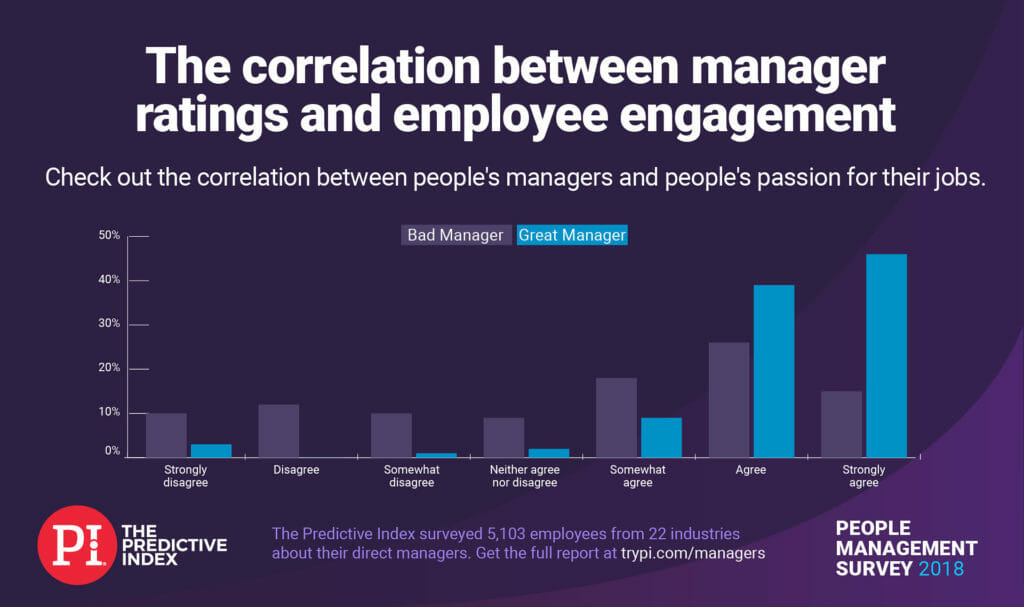
Anecdotally, we all know that managers can make or break your experience as an employee and the data we collected hammers home that point. We asked people what levels of passion and energy they had for their jobs. We also asked them to rate their managers on a scale from 1-10. For our purposes, we’re calling managers who got scores of 9 or 10 “great managers” and managers who got scores of 1-4 “bad managers.” Look at the engagement levels of employees based on whether they had great or bad managers:
Study question: Please tell us how you feel about the following statement: “Overall, I feel passion and energy for my job.
[chart id=”6″]
What’s more, look at the correlation between people’s feelings about their managers and their likelihood to look for a job at another company:
Study question: How likely are you to look for work at another organization in the next 12 months?
[chart id=”7″]
With the labor market being as tight as a knot and employee turnover costing a small fortune, bad people managers could be the demise of organizations.
2) Millennials outscore Gen Xers and Baby Boomers as managers.
As a Gen Xer (with many Gen X friends), this one caught me off guard. I’ve been in many a conversation with my contemporaries where our self-righteousness is on full display as we reaffirm one another’s observations about how Millennials are “just different” when it comes to the workplace: entitled, fragile, self-centered. All the stereotypes rear their heads in these conversations.
But one of our findings turned my generational smugness right on its head. According to those who report to them, Millennials are better as people managers than my generation or the Baby Boomer generation (if only by a smidge).
Manager ratings for different generations:
[chart id=”20″]
3) Good management is largely about giving the right amount of feedback.
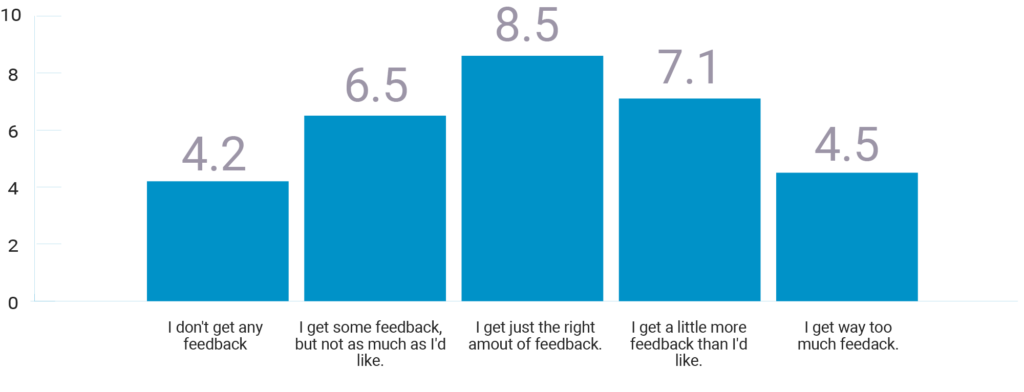
The chart below couldn’t tell a more vivid story. When employees feel they get “just the right amount of feedback,” they rate their bosses 8.6 out of 10 on average. When they report they don’t get enough feedback, the score plummets to 4.2! An interesting nuance to this chart is that if you’re going to err on the side of too much or too little feedback, it appears that too much feedback is the way to go.
Average manager ratings based on how much feedback respondents feel they get:
Over the coming weeks, we’ll be posting quite a bit of information about our findings from this ground-breaking study. But if you’re hungry to get all the information right now, just head to The Predictive Index People Management Study report for all the details.