I’ve studied the great leadership thinkers of our time: Drucker. Collins. Grant. Brown. Goldilocks.
Okay, that last one may need some explanation.
Goldilocks
In the classic fairy tale “Goldilocks and the Three Bears”, a young woman commits a felony by breaking and entering into a forest home. Once we look past that, we find that she subjects herself to various activities that produce a range of experiences:
- Porridge: Too hot, too cold, just right.
- Chair: Too hard, too soft, just right.
- Bed: Too hard, too soft, just right.
And the three barriers
In our work, we also experience a variety of conditions that can produce a range of outcomes. This can happen when our activity level, focus, stimulation, or other factors are too much, too little, or just right.
Sports psychologist Yuri Hanin found that as athletes’ emotional investment and interest increased, so did performance. However, if these escalated too far, performance would decrease. He identified that athletes have Individual Zones of Optimal Functioning (IZOF), and his model helps athletes dial in peak performance.
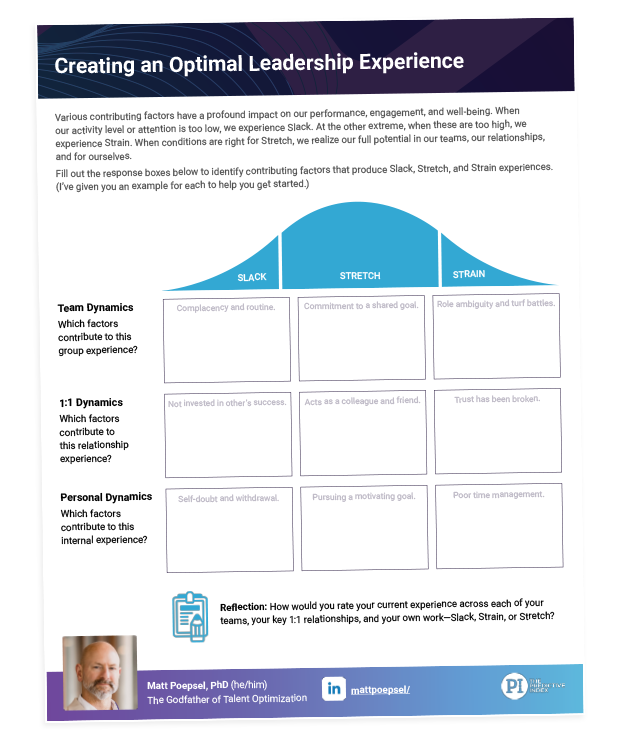
In our world of work, I see something very similar. In transporting his model to the workplace, I propose three distinct experiential states:
- Slack—too little
- Strain—too much
- Stretch—just right
It’s important to note that we do our work in complex layers of self, other, and team settings. The conditions that produce these outcomes may differ as a result.
I’ve created a worksheet to help you visualize these states, and identify what contributes to your personal experience of these Slack, Stretch, and Strain states. I’ve even given you a few examples from my own work experience to help you get started.
Moving through awareness, insight, and action
When we’re aware of the conditions that help us perform at our best, we’re more likely to create those conditions. We have much more control over our working environment than we often realize, but awareness proceeds insight and action.
Take a few minutes to complete the worksheet. Better yet, share it with your team members or those you work most closely with, and compare your answers.
We don’t have to run too hot or too cold in our work. When we raise our awareness of what makes for optimal experiences, we can channel our inner Goldilocks and make things just right.