
Whether your organization has 10 people or a thousand, one thing is probably true: Your leadership has been stretched thin this year.
Your chief executives have likely put out multiple fires over the course of the past nine months. And thanks to the uncertainty of the pandemic, whatever’s top of mind probably feels more urgent and pivotal than ever.
Success in 2021 hinges not just on nailing that No. 1 priority, but making sure other essentials—like your people—don’t fall by the wayside as a result of that urgency.
Executive teams are still figuring out strategy.
In its 2021 CEO Benchmarking Report, The Predictive Index surveyed 160 CEOs from various industries, asking them about their primary concerns and priorities post-COVID.
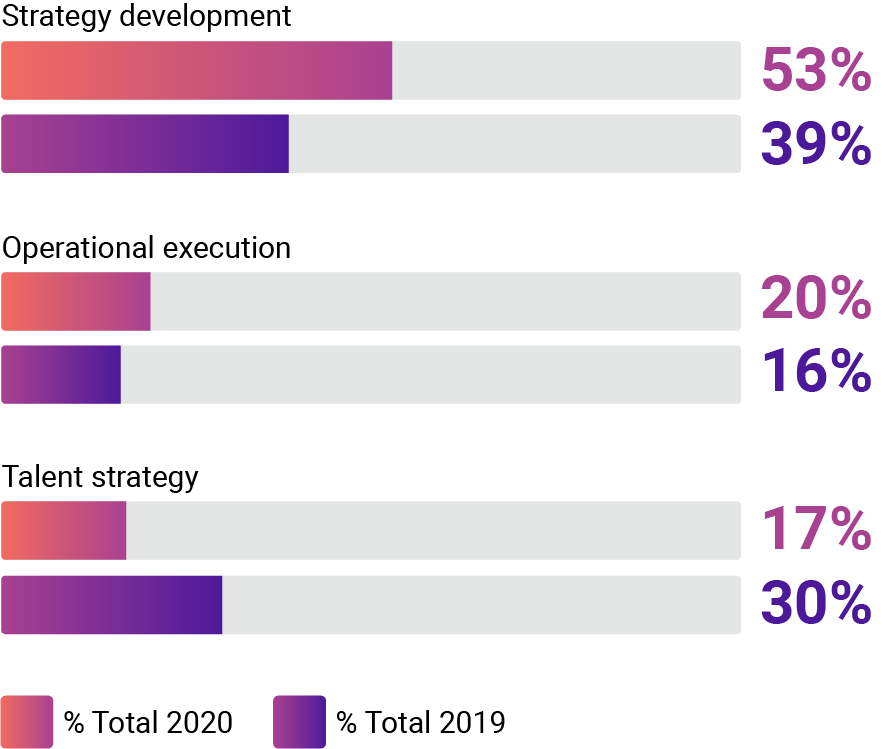
Among the key takeaways: A majority of respondents said “strategic development” is their top priority right now.
Here’s how the response data broke down:
It’s no wonder strategic development ranks atop the list this year. We’ve been rocked by an economic downturn, and bouncing back is no overnight process.
It’s telling that more than half of the executives surveyed are still focused on developing their post-COVID strategy. Remote work hurdles, tight budgets, and other limitations brought about by social distancing mandates all play a role there.
But the data also reveals that employees are less clear on strategy now than they were pre-COVID. So there’s a disconnect between the leadership making strategic shifts and the people actually executing the strategy.
Maybe it’s no coincidence, given that disconnect, that many of the same respondents are neglecting their talent strategy. Where talent strategy was the No. 1 priority for 30% of respondents in 2019, it’s top of mind for just 17% in 2020.
So many companies have been in pure survival mode throughout this year. But if you ignore talent strategy too long, you’ll eventually pay the cost, whether in the form of employee disengagement, turnover, or both.
Business strategy is people strategy.
Talent optimized organizations recognize that business and talent strategies aren’t mutually exclusive. In fact, you can’t reasonably expect buy-in from your people if you don’t account for them—if not make them the priority—alongside any strategic shift.
Read the full report to gain more insights into what CEOs are prioritizing, and how they’re tackling the myriad challenges presented by this pandemic. It’s essential that executives put people problems right up there with commercial concerns—because if you don’t have cohesive teams that understand your goals, you can’t truly tackle 2021 head on.