

Understanding a prospect’s specific social style allows sales reps to better communicate.
Key Takeaways
- The Social Styles Model explains how people communicate based on observable behaviors.
- It’s built on two dimensions: assertiveness (how people express ideas) and responsiveness (how people respond to others).
- These dimensions form four social styles: Controller, Expresser, Cooperator, and Analyzer.
- Each style approaches communication, relationships, and decisions differently.
- In sales, recognizing a prospect’s social style helps reps adapt their communication, build trust, and move deals forward more effectively.
What is the Social Styles Model?
The Social Styles Model is a behavioral framework that helps explain how people communicate and interact with others. Developed by psychologists David Merrill and Roger Reid, the model focuses on observable behaviors – how individuals express ideas and respond during conversations.
The framework is based on two key dimensions:
Assertiveness describes how strongly a person tends to express their opinions and ideas. Highly assertive individuals often communicate directly and move quickly toward decisions, while less assertive individuals typically take a slower, more deliberate approach.
Responsiveness reflects how openly a person expresses emotions and prioritizes relationships in communication. Highly responsive individuals tend to focus on people and interactions, while those lower in responsiveness often prioritize tasks, facts, and outcomes.
Together, these two dimensions create four distinct social styles that shape how people communicate and build relationships.
The Four Social Styles Matrix
The Social Styles Model organizes communication behaviors into a simple two-by-two framework based on assertiveness and responsiveness. By observing a person’s pace and focus during conversations, it becomes easier to recognize their style and adjust your communication approach.
| Low Responsiveness (Task-focused) | High Responsiveness (People-focused) | |
| High Assertiveness | Controller – Direct, results-focused, and decisive. | Expresser – Energetic, idea-driven, and enthusiastic. |
| Low Assertiveness | Analyzer – Careful, detail-oriented, and analytical. | Cooperator – Friendly, supportive, and relationship-focused. |
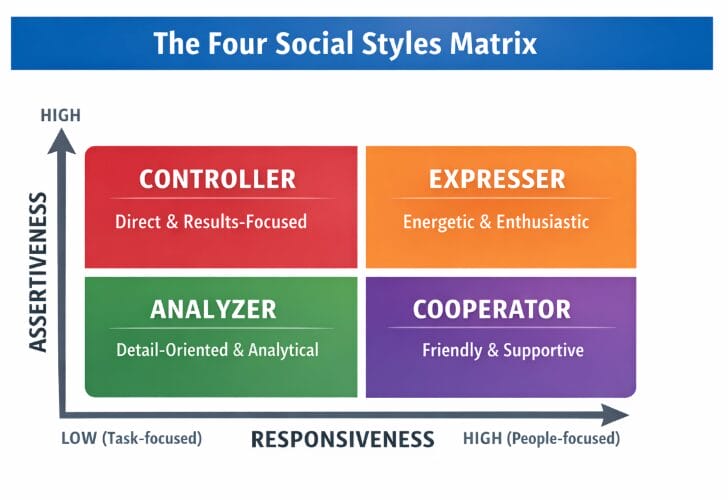
Recognizing these styles helps sales professionals adapt their approach, communicate more effectively, and build trust with prospects.
The Four Social Styles Explained
Each social style reflects a distinct way people communicate, process information, and approach decisions. Recognizing these patterns helps sales professionals understand what matters most to their prospects and adjust their communication style accordingly.
- Controller
Controllers are decisive and focused on outcomes. They tend to communicate directly and move quickly through conversations, preferring clear recommendations and efficient discussions. When engaging with a Controller, it’s important to focus on results and demonstrate how your solution helps them achieve their goals. - Expresser
Expressers are enthusiastic and future-focused. They enjoy discussing ideas, possibilities, and big-picture opportunities. Conversations with Expressers often benefit from energy and vision, especially when you can connect your solution to innovation, growth, or impact. - Cooperator
Cooperators value strong relationships and collaborative decision-making. They tend to prioritize harmony and trust, often taking time to understand how decisions will affect others. Building rapport and demonstrating support are key when working with this style. - Analyzer
Analyzers approach decisions carefully and prefer to review information before moving forward. They often ask detailed questions and rely on data, logic, and evidence to evaluate solutions. Providing clear facts and allowing time for consideration helps build credibility with this style.
Social Styles in the Workplace
Why social styles are important in a sales team
“Good” communication requires that the sales rep has a clear understanding of what makes it “good” for the person on the receiving end. The funny thing about this is that the rep may have a very different definition of “good” based on their own unique needs. Social styles, a simple framework focused on an individual’s pace and focus, can help a rep understand and adapt their communication style in a way that allows them to be on the same page as their prospect.

Managing different social styles during the sales process
Developing trust and credibility early in the sales process is powerful. It requires knowing the prospect’s social style, but more importantly, it requires an ability to apply this knowledge in an actionable way.
Take the Controller, for example. Prospects that exhibit this social style are highly results oriented, and will base their decisions solely on your ability to help them meet their goals. They do not want to waste time, so efficiency and a direct approach is crucial. Be sure to give them options, as this will provide them with the control they want in order to make a decision.
The Expresser, on the other hand, will rate situations and circumstances based on testimonials, happy clients, and your ability to make them look good. They will want you to handle the details, and like the Controller, efficiency is critical.
The Cooperator is all about harmony and relationships, so it is important to be pleasant, friendly, and supportive when working with this social style. They will respond well if you take the time to get to know them and help them make decisions that minimize any risk.
The Analyzer has little need or interest in pleasantries. These individuals will need to know that they have all the facts and that the information is accurate. Be precise and prepared to offer proof to back up your statements, and leave them with plenty of time to think things over.
Identifying and paying close attention to social styles provides reps with a roadmap to guide them in tailoring their approach to communication effectively with their prospects. This paves the path for trust and credibility to develop and begins a strong and mutually beneficial relationship.
While the Social Styles Model provides a simple way to recognize communication patterns, tools like the Predictive Index Behavioral Assessment give organizations deeper insight into the drives that shape how people communicate, collaborate, and perform at work.