A coworker once asked me: “How can you just sit here working in silence?”
As an audiophile, she preferred to listen to music while performing her design work. In fact, she had different playlists, each hand-curated to match the type of task she needed to perform.
I didn’t pick up her penchant for mood music, but I appreciated her intentionality.
Since then, I’ve learned to not only recognize key differences among my co-workers, but to appreciate them as a result. I love to celebrate others’ preferences! Of course, when I meet a new team member, it takes a bit of time to ferret out what similarities and differences we may have.
Highlighting – and celebrating – our differences
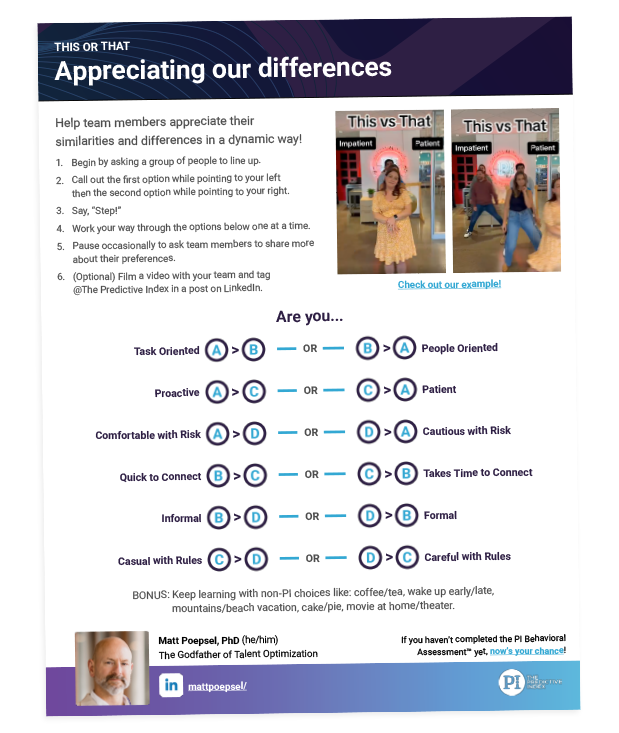
I was reminded of this recently when I saw a PI social media post getting in on the This or That trend on TikTok. It featured a team of co-workers self-selecting their personal preferences among various pairs of options. It was quick, fun, and oh-so-illuminating.
Sometimes, a given pair of co-workers learned they were similar in one way, yet different in others. For example, Courtney and Sarah are both outgoing, yet Courtney is more assertive while Sarah is more agreeable. It was great fun to see them look at one another as if to say, “Really?”
Fortunately, we don’t need a ring light and a selfie stick to get in on the fun and learning. Next time you’re with your team, you can pose a few opposing options and ask them to step toward their preference. It’s a great way to get the blood moving and the team gelling. And if you’re remote or hybrid, just substitute a hand raise for a side step, and you’ll get the same effect.
Now, you may be wondering: What types of options should I include?
Never fear—I’ve created a handy worksheet for you! It includes several pairs of work preferences and instructions on how to set up this fun learning exercise. If you’re a PI lover like me, you’ll find the factor-combination labels helpful as you try to take advantage of the common language afforded by our behavioral assessment results.
Have fun, and let the learning begin!