
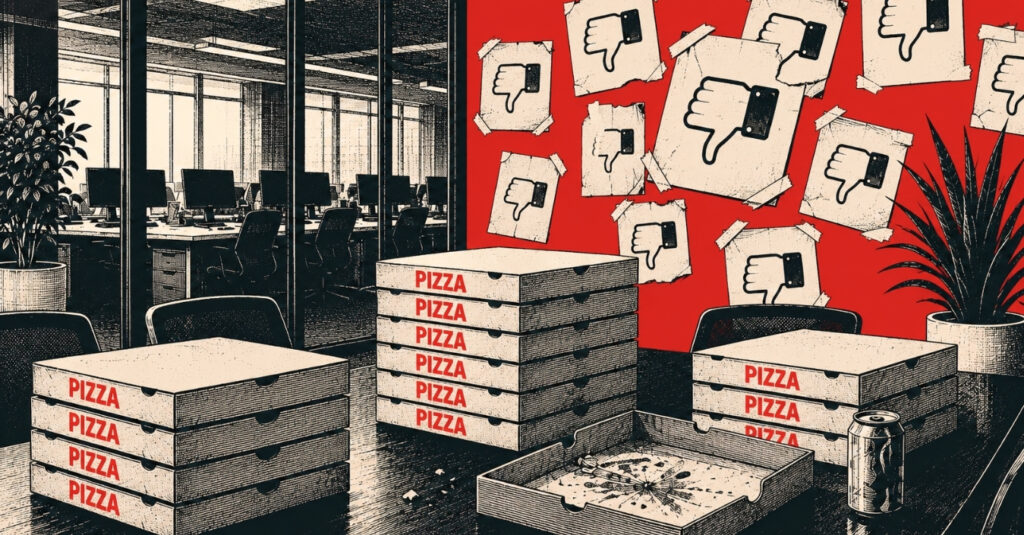
Meta just posted one of the best quarters in its history. Record revenue, profit up, stock fine. And according to its own CTO, morale is near one of the worst it’s been in 20 years. His words on a recent call: “the vibes are off.”
The easy read is “layoffs, obviously.” And yes there were thousands. But here’s the weird part: the angriest people at Meta right now don’t seem to be the ones who got cut. They’re the ones who kept their jobs and got drafted into a massive new AI unit, doing work they never signed up for. Same paycheck. Worse mood. Which tells you this wasn’t ever really about job security, and snacks and severance were never going to fix it. It’s a change management problem. If your company is anywhere near an AI restructuring, you’re going to want to see this.
What actually happened at Meta
Between early 2025 and May 2026, Meta ran several rounds of cuts, around 8,000 roles in May alone, about 10 percent of the company, while building out an aggressive AI-first strategy at the same time.
The big flashpoint here was a group called Applied AI, stood up in March and immediately filled with 6,500 engineers and product managers who had almost no say in the move. Many learned about it through a surprise email with a simple choice: join or quit. People who used to build products for billions of users were suddenly generating coding puzzles and problems to train AI models, the kind of expert annotation work that used to get handed to contractors. The work felt menial. Nobody could tell them what it meant for their career. One person described it to Wired as “literally the gulag.” Another called it “soul-crushing.” Plenty of them started calling themselves draftees.
Around the same time, Meta was installing software on employee laptops that logged keystrokes and screenshots to train AI, with no way to opt out at first. More than 1,500 employees signed a petition against it. (Meta later softened its stance and let people pause the tracking for up to 30 minutes at a time.) And median total comp dropped from $417K to $388K year over year, right as the company posted one of the most profitable quarters in its history.
So the anger makes sense. It’s worth being precise about where it’s coming from, though.
The real driver isn’t just job cuts
Layoffs hurt morale. No surprise there. What’s more telling is that the worst of the damage sits inside the Applied AI group, people who still have their jobs, who are paid extremely well by any standard, and who feel stuck anyway.
That points at something. This isn’t mostly about job security. It’s about meaning and autonomy.
When people lose ownership of work that matters to them, engagement falls apart quickly. That’s not a theory we’re floating. It’s about as settled as anything gets in behavioral science.
At PI we’d talk about it in terms of a person’s drives: the need for autonomy, for ownership, for doing work that actually uses what they’re good at. Take those away with no explanation and you don’t get mild frustration. You get the kind of checked-out disengagement that free snacks and an all-hands can’t fix.
Applied AI, the way Meta built it, is directive and top-down, tied to a big company-wide mandate. Some people are fine in that environment. Plenty of others can’t stand it. Move 6,500 of them in without asking who’s wired for it and who isn’t, and you get exactly what happened here: petitions, angry Blind threads, a CTO on a public call comparing the mood to the Cambridge Analytica days…
The AI pivot isn’t the problem. The problem is treating a behaviorally diverse group of people like they all run on the same wiring.
What this means for AI rollouts
This kind of restructuring is going to keep happening.
Companies that botch it will leave behind disengaged employees and a damaged employer brand. The ones that don’t will get one thing right. They’ll treat the human side of the change like it’s as real as the technical side. Three things I’m sure the many PI consultants of the world would recommend:
People need to understand why the work matters. Not the vague “this is the future” version, but the real one: how does this evaluation task connect to the product, and what does it mean for my career? The research on AI adoption is clear that people don’t push back because they’re rigid. They push back when the vision is fuzzy and they’re left to imagine the worst about what it means for them personally.
And nobody goes through a transition like this the same way. Some people move fast once they have clear direction. Others need the full picture before they’ll commit. Some get energized by a new problem; others come unglued when their whole area of expertise shifts under their feet. “You’re in Applied AI now” ignores all of it. Knowing how your people are built tells you who needs what when things get hard, which is where behavioral data earns its keep: less as a hiring filter, more as a management tool for exactly these moments.
Then there’s trust, which breaks fast and rebuilds slowly. The screen recorder [dystopian] thing matters less for what the software does than for what it tells people: we don’t fully trust you, and you don’t get a vote in how we watch you work. That signal poisons everything else around it. Once people feel surveilled instead of supported, your engagement data turns to noise. You get compliance, which looks like buy-in on a dashboard and isn’t.
Where HR comes in
HR’s job in an AI transformation isn’t to mop up after the decisions get made. It’s to be in the room while they’re being made.
Easier said than done. When a company is moving at Meta’s pace, the pressure to go fast is real, and the analysis on the table is financial and strategic. The human cost gets dealt with later, usually with a town hall and a shiny new perk.
Meta shows you the bill for that approach. The brand damage from a CTO publicly likening morale to a scandal will outlast the reorg by a long way. The engineers who quit will talk. The ones who stay and check out will be harder to win back than they were to hire in the first place.
To Meta’s credit, leadership didn’t pretend everything was fine. Zuckerberg admitted in a memo that the changes “caused distress” and that the company had made mistakes, and he ruled out further company-wide layoffs for the year. That’s the right instinct. It’s also after the fact, which is honestly the whole problem.
If you want to avoid that, you have to get behavioral intelligence into the restructuring conversation up front. Not just which roles to cut or merge, but what the people in those roles need to stay engaged, and what the plan looks like for them as individuals. That’s a very different ask than “go run a change-management comms plan.” It means treating your people as individuals with their own behavioral profiles instead of a headcount to be managed by policy.
Meta isn’t a special case. It’s a preview. The AI restructuring wave is rolling through every industry right now, and most companies are running the identical playbook: move fast, explain later, manage the wreckage. A few will get lucky. Most will end up with their own version of “the vibes are off.”
For what it’s worth, Meta’s first move after all this was better snacks and a cap on manager headcount. That’s not nothing. But if any of the above landed, you already know it’s nowhere near enough.
The fix was never more communication. It’s knowing your people well enough to see what the change is going to cost each of them. Before you ask them to go through it, not after.