
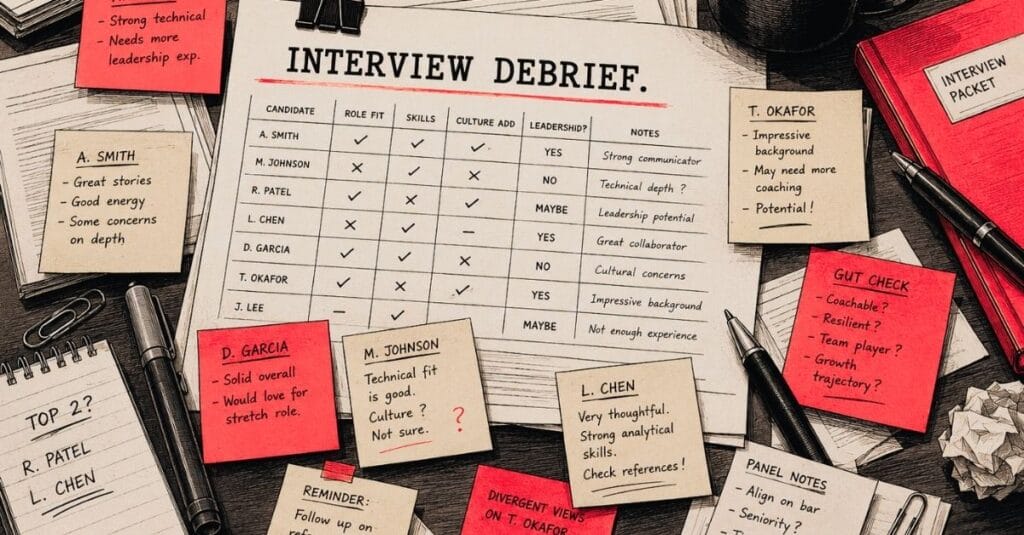
The interview is over. Now comes the part most hiring teams rush — or skip entirely.
What is an interview debrief?
An interview debrief is a structured review process that takes place after a job interview. It means different things depending on where you sit in the hiring process.
Hiring: For the hiring team, it’s a collaborative meeting where interviewers, the hiring manager, and the recruiter come together to share feedback, evaluate the candidate against the requirements of the role, and reach a hiring decision. It’s sometimes called a “wash-up,” and in larger organizations it may be facilitated by an HR partner rather than the hiring manager.
Candidate: For the candidate, it’s typically a follow-up call with the recruiter — a chance to talk through how the interview went, ask questions, and get clarity on next steps.
Who owns the decision?
The hiring manager typically holds final decision-making authority, but the debrief itself is a team exercise. Everyone who interviewed the candidate has a role to play. When that process works, the result is a hiring decision grounded in evidence rather than whoever made the strongest first impression.
When it doesn’t work, the consequences are familiar: drawn-out decisions, misaligned teams, and hires that looked right in the room but didn’t hold up on the job.
How to Run an Interview Debrief
A good debrief doesn’t happen by accident. These five steps keep the conversation structured, evidence-based, and focused on the right things.
1. Collect written feedback before the meeting
This is the single most important thing you can do before anyone sits down together.
Every interviewer should submit a scorecard or structured notes before the group discussion starts. When that doesn’t happen, and teams jump straight into conversation, the first person to speak tends to pull everyone else in their direction. It’s not a character flaw — it’s just how group dynamics work. Getting independent feedback in writing first means you actually have something to compare when the meeting begins. It also creates a paper trail, which matters more than people realize if hiring decisions get scrutinized later.
2. Assign a facilitator
Someone needs to run the meeting. In smaller companies, that’s usually the recruiter, but in larger organizations, it might be the hiring manager or an HR partner. The role isn’t complicated: keep things moving, make sure everyone contributes, and protect time for the candidates who actually need real discussion.
Without someone in that role, teams tend to burn time on candidates who are clearly a yes or a no, and then rush through the ones where the decision is genuinely difficult — which is exactly where you need to slow down.
3. Review each interviewer’s assessment in turn
Go around the room. Have each interviewer share their score and the specific evidence behind it, a moment from the interview, an answer that stood out, a concern that came up. The goal is to ground the conversation in what the candidate actually said or did, not how the conversation generally felt.
4. Identify where you agree and where you don’t
Pay attention to disagreement. If two interviewers came away with very different reads on the same candidate, that’s worth understanding. They may have asked different questions, evaluated different things, or simply noticed something the other person missed.
5. End with a clear next step
Every debrief should close with a decision: move forward, pass, or name exactly what you still need before you can decide. A follow-up interview, a skills assessment, a reference check — whatever it is, define it before you leave the room.
Questions to Ask During an Interview Debrief
These aren’t questions for the candidate. They’re questions for the facilitator to pose to the hiring team during the internal debrief. Their job is to keep the conversation grounded in evidence and make sure the discussion covers what it needs to.
| Question | Why it matters |
|---|---|
| “What specific examples from the interview support your rating?” | Moves the conversation away from general impressions and toward what the candidate actually said or did. If an interviewer can’t point to a specific moment, that’s useful information too. |
| “Were there any competencies from the job profile that didn’t get fully evaluated?” | Surfaces gaps before a decision gets made and flags whether a follow-up round is worth considering. |
| “Did anything in the interview change your assessment compared to the resume or screening call?” | Helps the team identify where expectations and reality diverged, in either direction. |
| “Are there any concerns that would be disqualifying? And are they actually deal-breakers, or things that could be addressed on the job?” | Separates genuine red flags from minor gaps before the team talks itself out of a strong candidate over something manageable. |
| “How does this candidate compare to the bar we set at the start of the search?” | Keeps the team calibrated against the role requirements rather than against each other. Comparing candidates to candidates is how standards drift. |
Interview Debrief Template
A debrief template doesn’t need to be elaborate. Its job is to make sure every interviewer is evaluating the same things, in the same way, before anyone starts talking.
A functional template should include:
- Candidate name and role
- Interviewer name and interview focus area (e.g., technical skills, leadership, culture)
- Scorecard rating per competency — typically on a 1–4 or 1–5 scale
- Key evidence for each score — specific examples from the interview, not general impressions
- Overall recommendation — advance, decline, or gather more information
- Any outstanding concerns or open questions
The hiring manager fills this out and distributes before the meeting. The template then becomes the foundation for the conversation, not a formality you fill out after the fact.
Using AI in Your Debrief Responsibly
AI in HR is still new territory for most teams. Everyone is experimenting, and the honest answer is that no one has fully figured out where it helps and where it gets in the way. Hiring decisions are high-stakes and deeply human, which makes this an area that deserves more care than most.
Debriefs in particular are worth paying attention to here. They can be surprisingly hard to run well. Opinions get personal, pressure builds to fill the role, and it’s easy for the conversation to get pulled by whoever feels most strongly rather than whoever has the best evidence. That’s exactly where having objective, behavioral data in the room makes a difference.
The goal isn’t to let an algorithm make the call. It’s to make sure the people in the room are working from the best available evidence when they do, and that the conversation doesn’t drift into territory that’s hard to defend later.
Key Takeaways
- An interview debrief is a structured post-interview meeting where the hiring team shares feedback, aligns on what they saw, and decides next steps. It’s not a casual conversation — it’s where hiring decisions actually get made.
- Written feedback submitted before the meeting is the single most important thing you can do to protect the quality of the discussion. It prevents the first voice in the room from setting the tone for everyone else.
- Every debrief needs a facilitator. Someone should be responsible for keeping the conversation structured, drawing out quieter voices, and making sure the hard cases get the time they deserve.
- Feedback should always be tied to specific evidence from the interview. Vague impressions aren’t just unhelpful — they can be a legal liability.
- The debrief should end with a clear outcome. Advance, pass, or define exactly what you still need before you can decide.
- Timing matters. The longer you wait, the weaker the debrief. Strong candidates won’t wait around while your team gets aligned.
- AI can help, but it works best when it’s adding objectivity rather than replacing judgment. The goal is to make sure the people in the room are working from the best available evidence when they make the call.
Most debrief advice focuses on the candidate. PI’s research points to something just as important: the people evaluating them.
Everyone in that room has a behavioral profile, a natural way of processing information, making decisions, and responding under pressure. A dominant, fast-moving evaluator and a methodical, evidence-driven one can interview the same candidate and come away with genuinely different reads. Neither is wrong. But without structure, the stronger personality tends to win.
That’s why PI looks at the debrief as a people problem as much as a process problem. When hiring teams understand their own behavioral tendencies and design the conversation around them, they make better decisions. Not because they followed a better checklist, but because they understood the room they were walking into.
We’ve created a template for you to build your own interview de-brief. Download it below!
