
When I applied for a job at The Predictive Index (PI), I went through the same steps you’d expect for a job application process, at least initially.
I found a job posting on Glassdoor that piqued my interest. I spent some time researching PI by looking through their website, reading their blog, and watching webinars. Next, I created a resume and cover letter that was tailored to the role. Then, I reached out to a PI employee in my LinkedIn network for an informational interview. This is where everything changed.
After the informational interview, I was given a link to complete The PI Behavioral Assessment™. As a naturally curious person, I took the assessment right away and received a report based on my results. I was surprised at the accuracy of the report. I remember reading it three times over and wondering how taking a 6-minute assessment could produce such a detailed description of my work style.
Later on that week, I had a phone interview with a recruiter and was given a link to complete the PI Cognitive Assessment™. Little did I know, both my behavioral and cognitive assessment results were being matched to a Job Target. And, this Job Target was a key factor in why and how I was interviewed.
“PI uses software to create the Job Target for you, providing written reports on your ideal candidate.”

What’s a Job Target?
A Job Target is a set of behavioral and cognitive requirements for a job. It serves as criteria that can guide an individual or team to assess a candidate’s fit in a role. Job Targets are created by answering a set of behavioral and cognitive questions about job requirements or created manually for those who are PI experts.
A Job target measures and compares candidates on the spectrum of four factors.
1. Dominance: Dominance is the drive to exert one’s influence on people or events.
2. Extraversion: Extraversion is the drive for social interaction with other people.
3. Patience: Patience is the drive for consistency and stability.
4. Formality: Formality is the drive to conform to rules and structure.
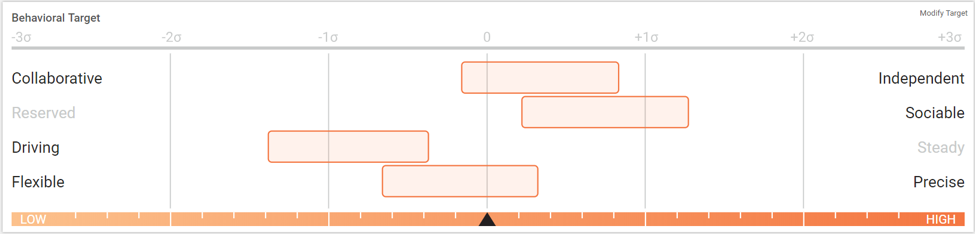
Above is the Job Target for the product marketing manager position I applied for two months back. To the untrained eye, a Job Target can look confusing. That’s why PI uses software to create the Job Target for you, providing written reports on your ideal candidate.
“The team was able to see that I was a great fit for the job through my interview and an understanding of my assessment results.”
Below is a brief description of the ideal candidate for the product marketing manager position that was decided on by my direct reports.
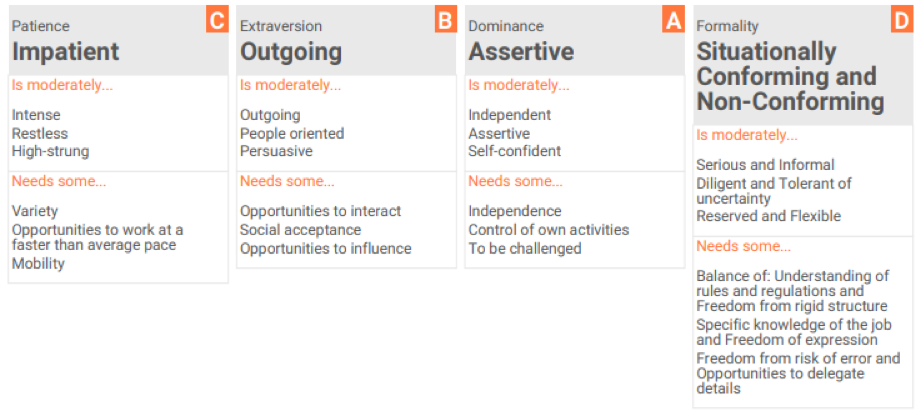 By looking at the Job Target and the report you can see that the ideal product marketing manager at PI is someone who is intense, people-oriented, independent, and diligent. They need opportunities to interact with others and be challenged. Is that who I am? Do I fit the ideal PI product marketing manager Job Target? Not exactly, but pretty close.
What you need to know about Job Targets
A Job Target is an additional tool that can be used to ease the hiring process and create a targeted candidate pool. My behavioral profile is not an exact match to the Job Target, but it is pretty close. When I came in for an in-person interview I was surprised by how specific the interview questions were. That is because the questions were tailored to my assessment results and the Job Target. Because I have a high Formality drive (I am precise and thrive in environments where there is structure) I was asked multiple questions about working on projects with no guidelines or rules and how I work with people who need less structure and are not interested in the details. I learned that I have the highest formality on the PI marketing team and that question was measuring my fit within the department. Although I was not the exact match for the position, through the structured questioning and insights created from the Job Target, the team was able to see that I was a great fit for the job through my interview and an understanding of my assessment results.
Why Job Targets are important
Job targeting is an amazing tool for:
- Hiring employees that are behaviorally and cognitively suited for the role
- Gaining insights from hiring stakeholders to create job requirements that satisfy the whole group
- Ensuring a new hire will be a good fit for a department or culture
- Analyzing the all-star performers in a role to attract top talent
- Reducing the time reviewing resumes, cover letters, and interviews
- Accessing targeted questions for interview questions based on behavioral and cognitive results of the candidate
Just remember, I wasn’t 100% aligned with my position’s Job Target. That’s why, even after deciding on the Job Target, you still need to follow through with conducting a full interview with your candidate, accompanied by the behavioral and cognitive assessments, to help you truly understand whether a candidate is a right fit for the role and the organization.