

It’s common to see scenario-based and situational interview questions used interchangeably, and while they do share a great deal of overlap, there are key distinctions all managers and HR leaders must be aware of to ensure they hire the right candidates the first time.
Situational questions typically present candidates with hypothetical, future-oriented scenarios designed to gauge how they would react in a specific situation they could encounter on the job. They evaluate a candidate’s problem-solving skills, judgment, and ability to think on their feet. How would the candidate act in the moment?
Scenario-based interview questions are also hypothetical but often have more depth and complexity than situational questions, involving multiple steps or problems within the provided scenario and drawing on general principles and ethics.
Each type of question seeks to determine how a candidate thinks, problem-solves, and makes decisions on the job, so both are essential during an interview.
Benefits of using these questions in interviews
Both types of questions focus on the future, but situational questions are typically more direct and centered on a single problem, while scenario-based questions are broader and involve multiple steps or factors.
Benefits of scenario-based interview questions:
- Provide a deep understanding of a candidate’s critical thinking, decision-making process, communication, collaboration, and conflict resolution skills, and practical job performance
- Assess how a candidate behaves under pressure
- Provide a standardized framework for evaluation, promoting fairness
- Directly evaluate the skills and capacity for the role
Benefits of situational interview questions:
- Assess problem-solving skills in real time
- Reduce interview polishing by going beyond standard questions that can be rehearsed
- Provide insight into a candidate’s adaptability
- Reveal job-specific skills by tailoring questions to the nuances of the role
- Gain insight into personality traits, ethical decision-making, and culture fit
As you can see, the benefits of both types of questions are quite similar. They are both valuable tools for HR leaders and interviewers, as they effectively predict job performance and provide key insight into a candidate’s skills. Where the questions differ slightly is in the scope and complexity of the hypothetical situation.

Optimize the entire talent journey.
Talent Optimization Essentials is the all-in-one, science-backed solution to hire, develop, and retain top talent.
Common themes in these types of questions
There are a number of common themes in both scenario-based and situational interview questions, which include:
- Teamwork and collaboration
- Problem-solving and decision-making
- Conflict resolution and interpersonal skills
- Adaptability
- Time management
- Proactiveness and taking initiative
- Accountability
- Learning from mistakes and handling failure
- Ethics
- Client relations and customer service
Example interview questions
Scenario-based interview questions
- “Customer satisfaction scores have dropped, you don’t know why, and you only have a limited time to determine the root cause. What steps would you take to investigate the issue and develop potential solutions?”
- “Your coworker consistently misses deadlines, which means you can’t get your own work completed on time. You’ve mentioned it to them casually before, but they continue to miss deadlines. How would you address this with them next?”
- “You’ve been working on a major project for several months, but overnight, the company changes its strategic direction, making your project no longer a priority. Your manager asks you to pivot to a completely different urgent task with a tight deadline. How would you react? How would you manage this change?”
- “You’re part of a cross-functional team working on a complex project. A team member from another department consistently resists input from others and prefers to work alone. How would you improve collaboration with them?”
- “You made a major mistake on a project that resulted in a significant setback for the team. What next steps would you take? How would you address the situation with your team and your manager?”
Situational interview questions
- “If you discovered a major error in a report that had already been sent to senior management, what would be your first steps to rectify the situation?”
- “What would you do if a critical piece of software you rely on to complete your work suddenly crashed and there was no immediate fix available?”
- “If you noticed a way to improve a process that no one had addressed before significantly, what would you do?”
- “If you had multiple urgent tasks with tight deadlines all landing at the same time, how would you prioritize your work?”
- “What would you do if you encountered a customer or client who was being rude or unreasonable?”
How to implement into the interview process
Prepare
Align questions with job requirements and company culture.
Take time to formulate scenario-based and situational questions that align with your business. What are some real examples from the workplace that you could ask about without giving away any names or company specifics?
For example, if you’ve had an issue with previous employees in the same role, what scenarios could you present to determine how a new hire would handle it?
What questions get to the core of your company culture?
Execute
Create a comfortable environment that encourages honest responses.
You’re not trying to trick anyone. Give interviewees the space to answer openly and honestly.
Consider how your own response and body language will make the person being interviewed feel.
Try not to lead the interviewee in one direction or another to get an honest answer, but don’t shy away from asking follow-up questions to probe deeper.
Don’t rely on memory alone. Take notes so that you can make informed and defensible hiring decisions.
Evaluate
Use standardized criteria to assess responses objectively. One way to do this is with the STAR method.
- Situation: What’s the context of the situation?
- Task: What were the interviewee’s duties and expectations?
- Action: How did the interviewee fulfill their duties? Did they go above and beyond?
- Result: Did the interviewee’s actions yield positive results? What did they learn?
This provides a clear framework you can use to quickly assess candidate responses while also providing them with a reliable structure to build their answer on.
How The Predictive Index can help
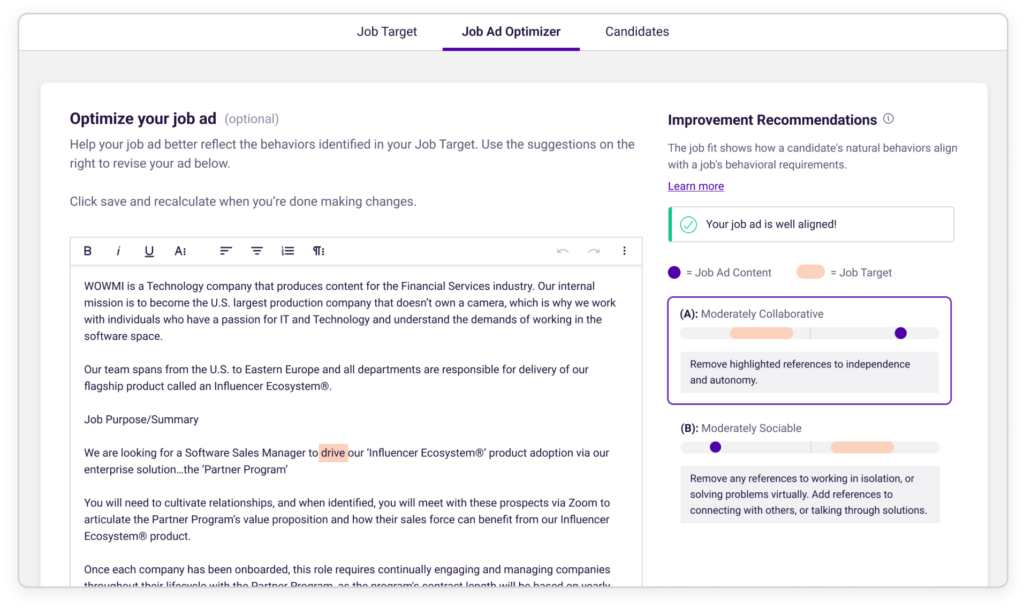
With PI Hire’s actionable and objective data seamlessly integrated into your hiring process, you can confidently hire and retain outstanding candidates. Minimize turnover and leverage both scenario-based and situational interview questions, together with your team’s input, to accurately assess the best fit.
Early alignment on data-driven decisions leads to smarter choices throughout the hiring journey, helping you discover the core qualities of a successful hire for every unique position.
Plus, you can leave the guessing games behind by sending our six-minute, scientifically validated Behavioral Assessment to your candidates before the interview even begins. We’ll identify their Reference Profile and specific behavioral pattern to determine the best match for the role you need to fill.