

If you search for how to improve forecast accuracy, you’ll find a lot of technical tips. Track macroeconomic indicators in real-time. Choose the right demand forecasting model. Recalculate forecasts in light of market conditions.
This is all solid advice.
But without the right people in place to execute, even the world’s best forecasting method won’t deliver the results you want. And without a stable workplace, employees in finance or supply chain management won’t operate at peak performance.
If you want to tackle your goal of improving forecast accuracy, look through a people lens.
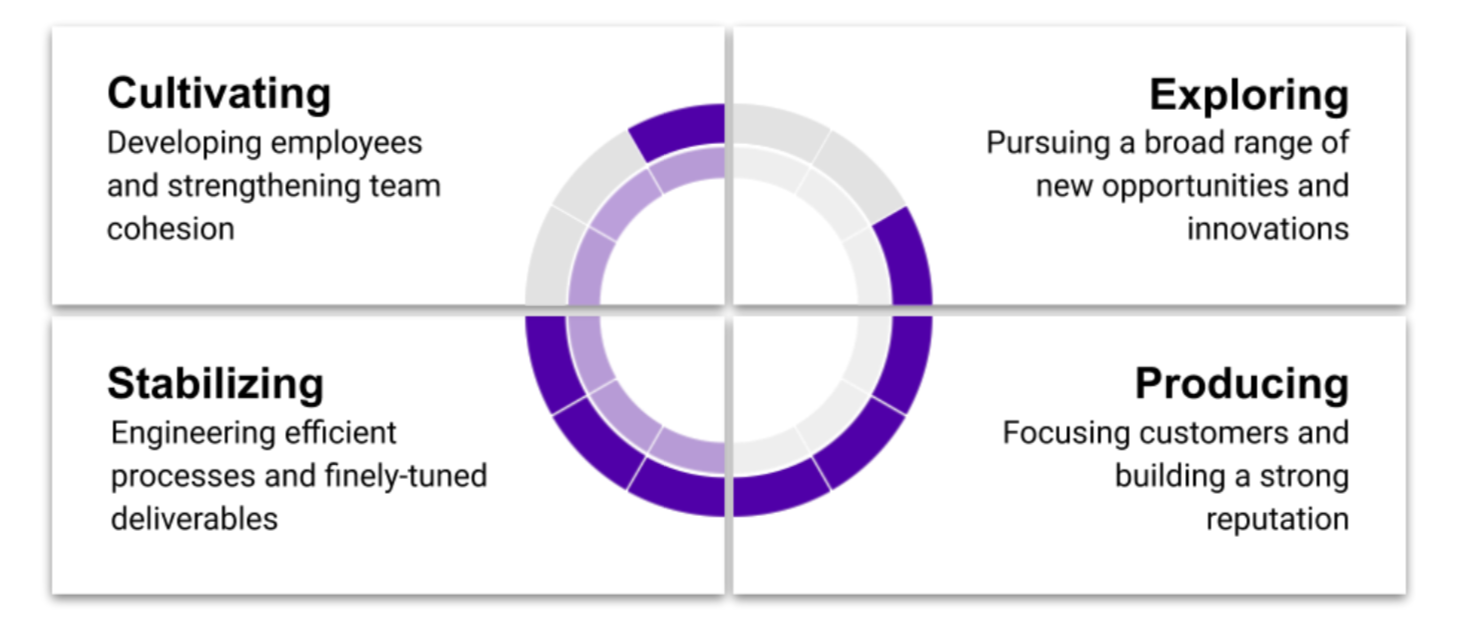
Fine-tuning your forecasting is a goal that maps to a Stabilizing business strategy. How you hire and manage matters. A great starting point is to hire people who are a good fit for a Stabilizing business strategy.
3 ways to improve forecast accuracy at your company
Here are three steps you can take to improve your forecast quality and accuracy:
1. Hire people who are naturally suited to planning and budgeting work.
Forecasting—or using historical data to predict the future—is complex. First, it requires a certain cognitive ability. Beyond that, it requires certain behaviors. To hit your goal of improving forecast accuracy, hire people who are naturally suited to do the work.
Sifting through sales data and making accurate forecasts requires stability and precision. Look for people who are analytical and deliberate—people who prefer to work with facts and figures.
The PI Reference Profiles that are best suited for these roles are “Stabilizing profiles.” These include Operator, Guardian, Artisan, and Specialist. Hire people who fit this mold. It will increase the reliability and accuracy of your forecast and business planning process.
Do you know the most common reason companies terminate employees? According to the 2020 State of Talent Optimization Report, they lack the behavioral fit or intelligence needed for the role. Hire with behavioral and cognitive fit in mind. This can help you pinpoint people who can do the job well.
2. Manage your Stabilizing employees to peak performance.
When it comes to Stabilizing profiles, the key to peak performance is providing a stable environment where they feel safe.
Shelter team members on the finance and business planning teams from constant change (e.g., changing priorities). And don’t forget about any operations folks on your marketing or sales teams; they need the same consideration.
Stabilizing profiles crave some isolation and time to develop their plans and forecast. Don’t expect immediate responses to inquiries or changes—not because these people are slow, but because they’re diligent and thorough. They may need more facts before they can provide a response. If you push them, they might succumb to the pressure and make mistakes. Stabilizing profiles are wired to avoid mistakes, so this can be really demotivating.

Stabilizing profiles prefer to work at a steady pace. And they aren’t dominant by nature. So leaders of budgeting or business planning teams shouldn’t delegate tasks that involve:
- Responding rapidly to the rest of the company
- An immediate change to the forecast
- Assertiveness (e.g., saying no to a new opportunity not included in the budget)
Also, the tailor the way you recognize Stabilizing profiles for a job well done. They tend to be more task-oriented than people-oriented. Because of this, public recognition may make them uncomfortable. Stabilizing profiles crave private recognition. At your next 1 on 1, compliment their skills, loyalty, sense of duty, and depth of knowledge.
Finally, in coaching conversations, encourage them to think outside the box. Stabilizing profiles are risk-averse. Innovative, big-picture thinking—and all the risk that comes with it—may not come naturally to them. But to solve certain challenges, it can come in handy.
3. Invite Stabilizing profiles to your senior team meetings.
In senior team meetings, Stabilizing profiles help everyone stay focused on agreed-upon goals. They also highlight the process and/or systems implications of any new changes to the strategy. Stabilizing profiles help increase company-wide reliability and accuracy.
In some companies, all or most of the senior leadership team has Exploring profiles. For example, Mavericks, Captains, Venturers, and Persuaders. And there’s a tendency to dive headfirst into new ideas. To improve business performance, always loop in members of your Stabilizing teams. They can act as a counterweight to keep things on track.
Improving forecast accuracy is possible when you take a people-first approach.
Improve forecast accuracy is the second most chosen strategic statement in the PI Strategy Assessment™. That’s because the forecasting process is critical. It helps inform long-term demand planning and budgeting. Taking a people-first approach to improving forecast accuracy in your company is well worth the effort. After all, there’s real business value in practicing talent optimization.
Before you invest in a pricey demand sensing platform or throw your entire sales forecast out the window, take a step back. Ask yourself: Do I have the right people in the right seats?