

Vinayak Ranade is the Founder and CEO of Drafted, an innovative referral hiring solution.
Employee referrals are known to result in more efficient hiring. As you can see in the below SlideShare, U.S. companies hire 29 percent of their workforce through referrals—and at least 88 percent of employers love employee referrals. At companies like Ernst & Young, referrals can account for up to 45 percent of non-entry level hires, according to The New York Times.
At the same time, every week we see something in the news reminding us that most businesses have a ways to go when it comes to diversity and inclusion in the workplace. Take a look at these survey results showing the percentage of women within various companies—on the low side we see 23 percent with a median of 39.5 percent.
If you’re in the recruiting and talent business (i.e. any business), it’s not unusual to hear something like:
“We want fewer referrals, because we’re focusing on diversity, since you know, birds of a feather…”
There is truth to this idea. Research says people tend to refer people like themselves, so naturally, some recruiters and employers believe that having a healthy referral program is unhealthy for their diversity and inclusion initiatives.
However, saying you don’t want more employee referrals for diversity reasons is throwing the baby out with the bathwater. More referrals doesn’t mean less diversity, necessarily. You can accomplish your workplace diversity goals by being more thoughtful about your referral program, instead of just abandoning it.
Here are four ways you can create a diverse employee referral program at your company:
The first way to get more diversity through referrals—JUST ASK.
New research from the Kapor Center suggested that you can turn referrals in favor of diversity by strongly encouraging not just any referrals, but diverse referrals. It seems so obvious once you think about it. If you want more diverse referrals, just ask.
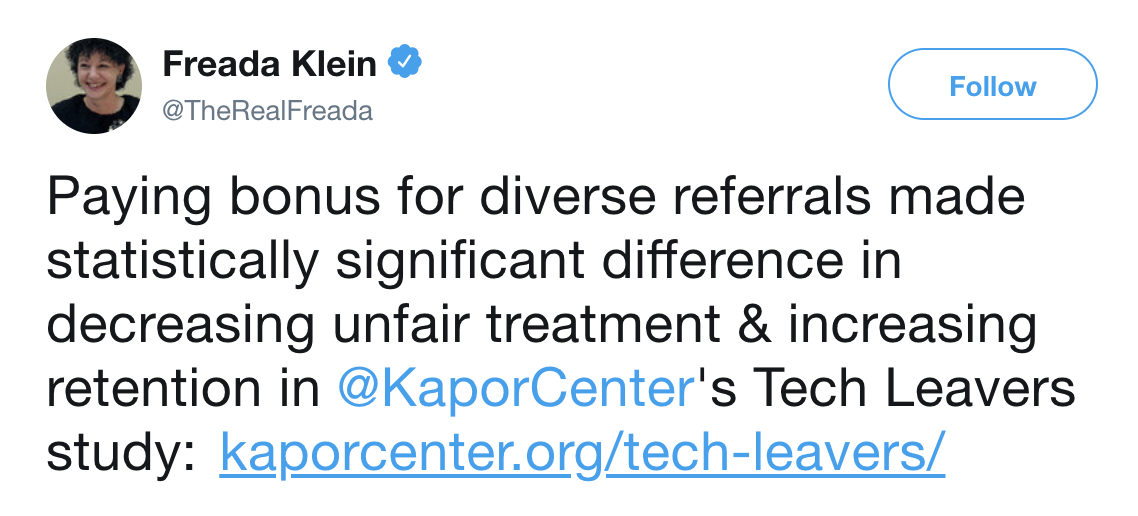
Further, the Kapor Center’s studies also found that offering a referral bonus specifically for underrepresented minorities moves the needle more than several other popular methods. These include the appointment of a Chief Diversity Officer (a popular Silicon Valley bandaid) as well as unconscious bias training, which can potentially have the opposite effect. As Harvard sociologist Frank Dobbin said to Vox, “Training can bring bias to the surface … it can activate stereotypes.”
The second way to get more diversity through referrals—Ask for leads, not referrals.
This HBR article talks about how Pinterest, a premier tech company in Silicon Valley, was able to move the needle on their workforce diversity efforts with a very simple trick. Instead of asking for “referrals” (a word that carries a lot of weight), they asked employees for “loose referrals” or “leads” and let the recruiting team decide whether the candidate made the cut.
As Candice Morgan, Head of Diversity at Pinterest, said in the article: “We found that people tend to refer job candidates who look like themselves, so we decided to ask people for loose connections and leads instead of referrals.”
This way they were able to combat unconscious bias that might play into referrals, and also get a broader, more diverse set of candidates at the top of the funnel.
The third way to get more diversity through referrals—Ask minorities and URGs for referrals.
If you’re not convinced yet and still don’t think there’s a cure for “birds of the same feather,” there’s an obvious solution: ask a better set of birds.
Join 10,000 companies solving the most complex people problems with PI.
If you can find ways to more effectively encourage and incentivize under-represented groups within your company to make more referrals, that will increase the diversity at the top of your candidate pipeline.
The fourth way to get more diversity through referrals—Ask your community.
Forty percent of all referrals originate from a non-employee source. This means that someone has to network his or her way through the community to one of your employees in order to get referred.
Now, if you want all the good parts of referrals (trusted source, higher response rates, better candidate engagement, faster time-to-hire, lower cost-per-hire, etc.) but don’t want people that look and smell exactly like your employees, a no-brainer would be to simply ask people that aren’t your employees.
Every company has a community—friends, family, investors, customers, social media followers, and so on. With the right personalized and targeted messaging, you can engage different parts of your community in helping you find the best talent from a variety of places.

Vinayak Ranade is the Founder and CEO of Drafted, the best referral hiring solution. Prior to Drafted, Vinayak served as a Director of Engineering & Recruiting at KAYAK, which was acquired for $2.2B. Vinayak holds a B.S and M.Eng in Computer Science from MIT, and is certified both for the GDPR and bartending. He enjoys writing, speaking, and dancing in his spare time.