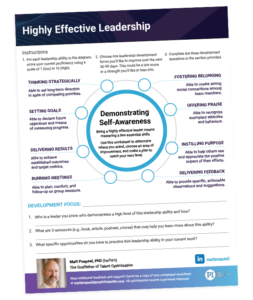

Unless you’re a solopreneur, odds are you’re not the most effective leader in your company. There can be only one, after all. Fortunately, each of us is on a journey. You may be hovering near the top of the leadership leaderboard, or a bit further down than you’d like. Whether you’re a seasoned pro or a relatively new leader, you can turn to well-established leadership essentials to identify important gaps, and guide your future development.
I’ve had the pleasure of studying and practicing leadership for more than 25 years. I’ve drawn lessons from the U.S. Marine Corps, Harvard Business School, rapidly growing software companies, and everywhere in between.
Here’s what I’ve discovered about the most effective leaders in any organization:
1. They have a high level of self-awareness.
Perhaps the single greatest requirement of leaders is to develop and maintain accurate self-awareness. This is more difficult than it may seem. Researcher Tasha Eurich discovered that while 95% of us believe we’re self aware, only 10-15% of us actually are. Without self-awareness, nothing in your leadership can improve.
2. They craft winning strategies.
Too many leaders confuse busyness with real value creation. Rather than get swept away by a series of loose activities, effective leaders make time to think strategically. This is not merely the domain of the C-Suite. “Level down” leaders must absorb higher-order strategies, then devise their own specific to their area of responsibility.
3. They are intensely goal-oriented.
Goals focus collective energies and provide important context for decision-making. The most effective leaders don’t just create goals and move on. They monitor progress and make necessary adjustments until the objective has been met. Bonus: Learn how to set the SMARTEST goals.
4. They consistently deliver results.
A leadership reputation is earned over a long period of time, and through demonstrating a high degree of reliability. While an effective leader’s objectives change over time, their performance doesn’t. They find ways to unite team members and deliver outsized performance outcomes.
5. They run meetings that don’t suck.
A recent Slack survey found that according to more than 18,000 respondents, as many as 43% of meetings could be eliminated with little to no significant consequences. The only thing worse than “yet another” meeting is a poorly run meeting. Effective leaders understand that meetings can have value when they’re run properly.
6. They deliver the right feedback at the right time.
Effective leaders don’t shy away from providing constructive feedback. Whether in the moment, during a regularly scheduled 1-on-1, or during an annual performance review, effective leaders share their perspective in a way that benefits the other party, even when it may not be comfortable to hear.
7. They freely offer praise where deserved.
When a team member goes above and beyond what’s expected, an effective leader seizes the opportunity to recognize the effort. Offering recognition reinforces constructive behaviors, boosts morale, and demonstrates a high level of team cohesion. Effective leaders are happy to share the spotlight with other star performers.
8. They make others feel a part of the team.
In a post-pandemic and increasingly hybrid working environment, isolation and loneliness have become all too common. Effective leaders understand that high-performing organizations and teams require a strong social fabric. They make time and space for team members to connect and strengthen social bonds.
9. They help others see their impact.
Workers want to experience a sense of purpose and meaning in their work. This isn’t always easy, and effective leaders understand that it’s up to them to help bridge the gap. By helping employees connect the dots between their day-to-day efforts, personal purpose, and organizational objectives, effective leaders elevate performance and strengthen team commitment.
Let’s face it: When it comes to being your company’s most effective leader, the odds aren’t in your favor. Even so, you can take comfort in knowing that highly effective leaders weren’t simply born this way; they had to work at it. You can do the same. You just have to want to get better, reflect on our improvement opportunities, and put in the work to up your game. That’s why I’ve created the accompanying worksheet to help you get started.
Leadership is about the choices you make. Will you quickly move on to the next trivial task? Or will you prioritize your leadership development by completing the worksheet?
The choice—as always—is yours.